Key Takeaways for Specifiers and Buyers
- “Glass” is not one substrate. Float glass, coated glass, laminated glass, mirror backing, insulating glass units and aquarium glass each present a different bonding surface. One sealant will not be right for all six.
- There are two different jobs on a glass facade: bonding glass into an assembly, and sealing the joint around it. They use different products and different standards.
- Acetoxy sealants bond to glass extremely well and cure fast — and must never be used on mirror backing or bare metal. The acetic acid released during cure attacks silvering and corrodes aluminium.
- On a curtain wall the structural sealant carries load and the weatherseal keeps water out. They are not interchangeable, and the structural one is governed by GB 16776.
- Extrusion rate spans a very wide range on glass products — our PR-618 delivers 2,076 mL/min against 543 mL/min for the curtain wall sealant. Match the product to the production method.
Glass is the substrate buyers assume is simplest, and it is the one where assumptions cause the most failures. A silicone sealant that bonds beautifully to float glass can destroy a mirror, corrode an aluminium frame, or fail on a coated low-E surface that nothing will stick to without a primer.
This guide separates the jobs that “glass silicone sealant” is asked to do, explains which chemistry suits each, and shows how to compare products on their actual test data.
1. “Glass” Is Not One Substrate
Before selecting a sealant, identify which of these you actually have:
| Glass type | Bonding surface | Key risk |
|---|---|---|
| Float / clear glass | Bare silica surface | Lowest risk. Both acetoxy and neutral cure bond well. |
| Coated glass (low-E, reflective) | Metal oxide coating | The coating, not the glass, is the bonding surface. Adhesion must be tested on the actual coating. |
| Laminated glass | Glass face plus exposed interlayer edge | The PVB interlayer edge is not a bonding surface; sealant must not be relied on to seal it. |
| Mirror | Backing paint over silvering | Acetoxy sealants attack the backing and cause black-edge corrosion. Neutral cure only. |
| Insulating glass unit (IGU) | Edge seal of the unit | Requires a structural-grade secondary seal, not a general weatherseal. |
| Aquarium / thick glass | Bare glass, high load | Needs high bond strength plus compatibility with continuous water exposure. |
Most “my sealant failed on glass” cases trace back to one of the middle four rows: a coated surface that was never tested, a mirror sealed with acid-cure product, or an IGU edge sealed with a weatherseal.
2. Two Different Jobs: Bonding vs Sealing
On a glass facade, the silicone sealant is doing one of two things, and the distinction determines the standard that applies.
Bonding — the sealant is on the load path
The glass is held by the sealant. This is structural glazing, and in China it is governed by GB 16776-2025. It requires tensile adhesion testing at 23 °C, 90 °C and −30 °C, an alkane plasticizer check, and a designed joint. Our PR-999 records 0.85 MPa at 23 °C, 0.71 MPa at 90 °C and 1.44 MPa at −30 °C, with 205% elongation at maximum tensile strength.
Sealing — the glass is mechanically fixed
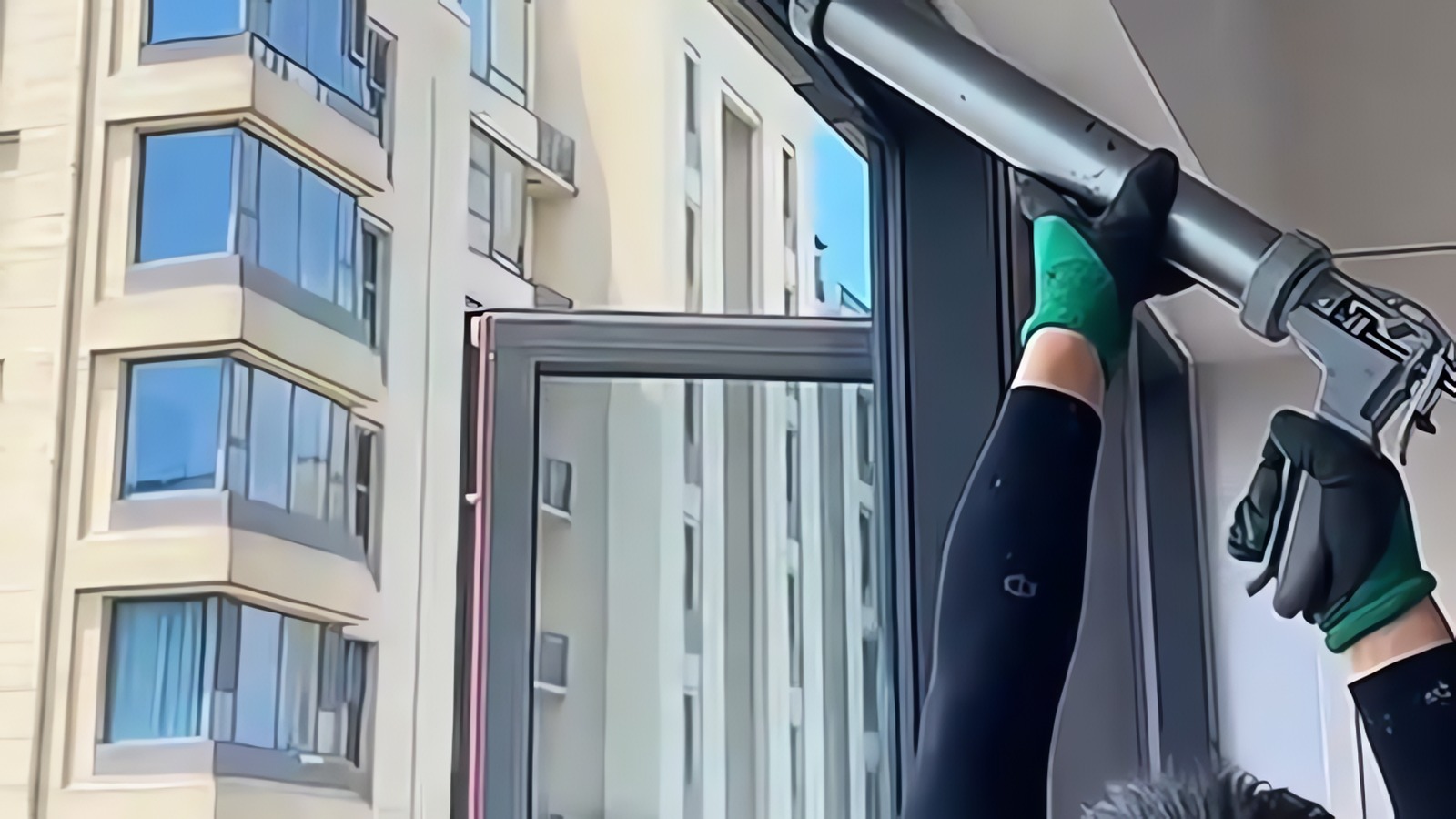
The glass is already held by a frame, gasket or fitting, and the sealant keeps water and air out while accommodating movement. This is a weatherseal, governed by GB/T 14683-2017. Strength matters far less than movement capability, adhesion after water immersion, and elastic recovery.
Specifying a weatherseal for a structural joint is a safety failure. Specifying a structural sealant for a simple weatherseal joint is an unnecessary cost. Decide which job you have before comparing products.
3. Acetoxy vs Neutral Cure on Glass
This is the single most consequential chemistry decision on glass work.
| Property | Acetoxy (acid cure) | Neutral cure |
|---|---|---|
| Cure by-product | Acetic acid (vinegar smell) | Alcohol or oxime (low odour) |
| Adhesion to bare glass | Excellent | Excellent |
| Cure speed | Very fast — our PR-618 is tack-free in 0.2 h | Slower — typically 0.8–1.2 h |
| Mirror backing | Not permitted — attacks silvering | Required |
| Bare metal / aluminium | Not permitted — acid corrodes metal | Required |
| Natural stone / marble | Not permitted | Required (non-staining grade) |
| Cost | Lower | Higher |
The practical rule: acetoxy for bare glass where speed and cost matter and there is no metal, mirror or stone in contact; neutral cure for everything else.
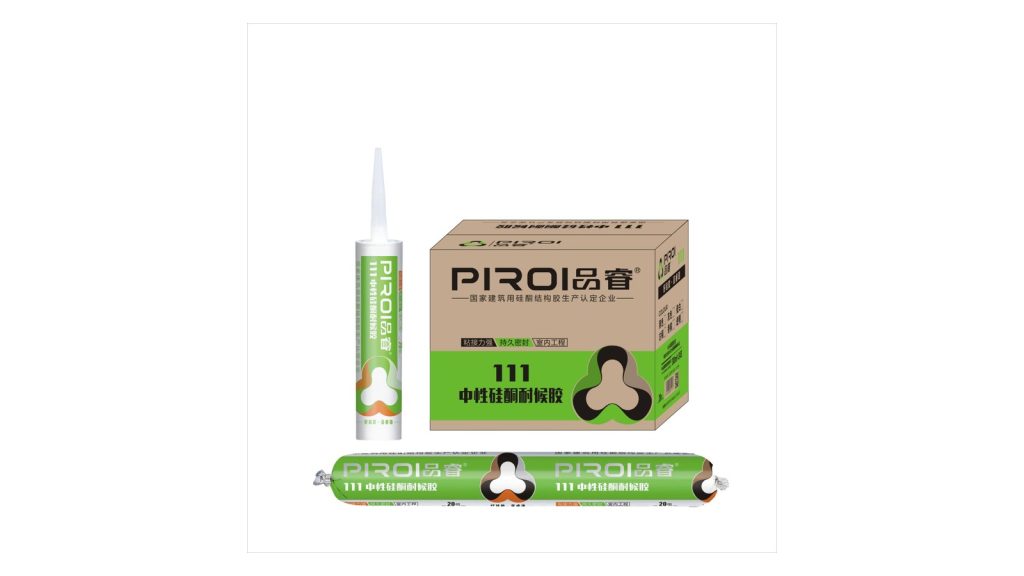
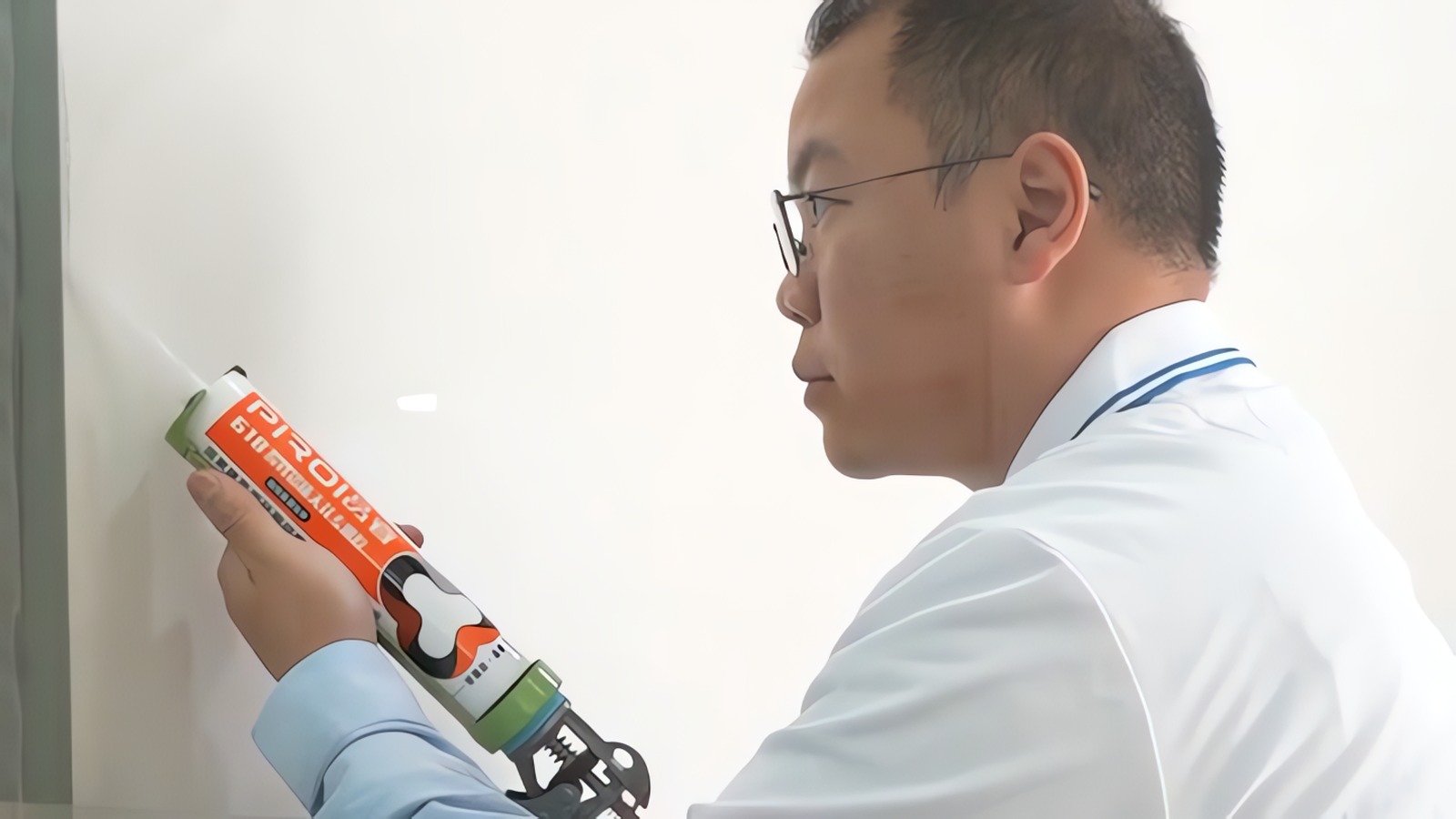
PR-618 is our acetoxy glass and glazing silicone sealant. Its extrusion rate of 2,076 mL/min and 0.2 h tack-free time make it a production-line product — glass units can be handled and packed the same shift. Its modulus is deliberately low: 0.3 MPa at 23 °C (limit max. 0.4) and 0.4 MPa at −20 °C (limit max. 0.6), so it stays flexible in cold conditions rather than becoming brittle. Adhesion at maintained extension shows no failure.
What it must not be used for is equally clear: not on mirror backing, not against bare aluminium or stainless steel, and not on natural stone. For those, use a neutral-cure product — PR-228 for mirrors, PR-304 for stainless steel, PR-602 for stone.

4. The Curtain Wall Joint: Two Sealants, Two Standards
A unitised curtain wall typically has both sealants in the same assembly, performing different jobs.
| Structural sealant | Weatherseal | |
|---|---|---|
| Example | PR-999 | PR-520 / PR-888 |
| Standard | GB 16776-2025 | GB/T 14683-2017 |
| Job | Transfers wind load from glass to frame | Seals the joint; accommodates movement |
| Classification | — | SR-I-F-25HM (PR-520) |
| Tensile modulus | Higher — carries load | 0.8–0.9 MPa (PR-520 / PR-888) |
| Key durability test | Adhesion at 90 °C and −30 °C | Adhesion after water and thermal cycling |
| Extrusion rate | — | 543 mL/min (PR-520) — highest in our range |
The classification SR-I-F-25HM on PR-520 is worth decoding, because it appears on tender documents: it identifies the product type and the movement and modulus class, and it is the line a specifier should match against the joint design. If the joint is designed for 25% movement, the sealant classification must support it.
Note the extrusion rate difference: PR-520 at 543 mL/min is the highest in our range, and it exists for a specific reason — curtain wall sealing is a high-volume, high-access-cost operation. Every minute saved per joint multiplies across a facade.
5. Insulating Glass Units: A Different Requirement Again
An IGU is not a glazing panel with a sealant around it — the unit itself is sealed at manufacture, and the sealant that holds it together is part of the product.
The edge seal has two parts. The primary seal (usually butyl) keeps moisture out of the cavity. The secondary seal provides the structural and durable bond between the two panes. The secondary seal is where a structural silicone sealant is used, and because it carries load and must last the life of the unit, it requires a structural-grade product — the same GB 16776 discipline as structural glazing, not a general weatherseal.
This is a common specification error: an IGU secondary seal written as a “glazing sealant” and supplied with a weatherseal. The consequence is not immediate — it appears as fogging, seal creep or unit failure some years later, by which time the facade is complete.
6. Choosing by Numbers: A Comparison
| Product | Chemistry | Best for | Extrusion rate | Tack-free |
|---|---|---|---|---|
| PR-618 | Acetoxy | Bare glass bonding, aquarium, indoor glazing | 2,076 mL/min | 0.2 h |
| PR-520 | Neutral | Curtain wall & facade weatherseal | 543 mL/min | 0.8 h |
| PR-888 | Neutral | Exposed facade, full durability testing | 519 mL/min | 1.2 h |
| PR-602 | Neutral | Natural stone and stone cladding | 230 mL/min | 0.7 h |
| PR-999 | Neutral | Structural glazing (load path) | — | 1.0 h |
Two figures in this table deserve comment. PR-602 holds 92% elastic recovery (minimum 80) — it is formulated specifically so that a stone facade is not permanently stained by a sealant that deforms and holds dirt. PR-618’s extrusion rate of 2,076 mL/min is more than ten times the minimum requirement of 150 mL/min; that is what makes it viable on an automated glazing line.
Frequently Asked Questions
Can I use one sealant for both the structural bond and the weatherseal?
No. The structural sealant must meet GB 16776-2025 and is designed to carry load. The weatherseal meets GB/T 14683-2017 and is designed to move. Using one product for both jobs either compromises the bond or over-specifies the joint — and in the first case it creates a safety issue.
Why can’t I use acetoxy sealant on a mirror?
Acetoxy sealants release acetic acid while curing. On a mirror, that acid attacks the backing paint and silvering, producing the characteristic black-edge corrosion that spreads across the mirror over time. Use a neutral-cure mirror sealant such as PR-228.
My glass has a low-E coating — will a standard sealant bond to it?
Not reliably. The bonding surface is the coating, not the glass, and adhesion depends on the specific coating. This must be confirmed by an adhesion test on the actual project glass. Some coatings require a primer; some are incompatible with certain sealants.
What does “SR-I-F-25HM” mean?
It is a classification from GB/T 14683-2017 that identifies the product type together with its movement capability and modulus class. In a specification, it is the line that must match the joint design — a 25% movement class sealant is not the right product for a joint designed for wider movement.
Is a faster-curing sealant always better?
Only where handling speed matters, such as an assembly line. On site, a very fast tack-free time can be a disadvantage: the sealant skins over before the applicator has finished tooling the joint. Match cure speed to the production method — that is why we offer both 0.2 h and 1.2 h products.
Do you supply test reports and samples?
Yes. Specifiers and contractors can request GB 16776-2025 and GB/T 14683-2017 reports for the products above, and free substrate samples for adhesion and staining testing on your own glass, through our contact page.
For the frame side of the same joint — uPVC, aluminium, timber and RV windows — see our frame material selection guide for window and door sealants.
How to choose glass glazing silicone sealant for facades
Facade glazing is the position where the choice matters most, because the joint is large, exposed and not maintainable. The sequence that works:
- Decide the position. Structural (load-bearing, GB 16776 / ASTM C1184) or weatherseal (GB/T 14683 / JC/T 485). A facade normally has both, on different lines of the same elevation.
- Check the glass edge. Coated, reflective and low-iron glass behave differently at the edge. Neutral cure is mandatory where the bead touches a coated edge; an adhesion test on the actual glass is worth more than any datasheet.
- Size from surface temperature. Glass moves less than aluminium but the frame moves more, and the joint between them sees the difference. Use the real surface temperature range — dark glass in sun runs well above ambient.
- Confirm the colour against the facade. A grey bead on grey glass reads differently from the same bead against aluminium. Approve on a cured sample, not a wet smear.
- Ask for the durability evidence. For an exposed facade, mass loss and elastic recovery are the two figures that predict service life. Our PR-888 reports 4.2% mass loss against a limit of 8%, and 92% recovery against a minimum of 80%.
The same logic applies whether you are buying in China or elsewhere; the standards named will differ, which is why we also publish a comparison of Chinese and ASTM sealant standards.
For facade work specifically, the sequence above is the practical answer to how to choose glass glazing silicone sealant for facades: decide the position, check the glass edge, size from surface temperature, confirm colour on a cured sample, and ask for the mass loss and recovery figures behind the grade.