Key Takeaways for Specifiers and Buyers
- A sealant (密封胶) is designed to move. An adhesive (胶粘剂) is designed to hold. The same silicone chemistry can be formulated to do either, which is why the two are so often confused.
- The practical dividing line is modulus and movement capability, not chemistry. A low-modulus sealant stretches; a high-strength adhesive carries load.
- Structural silicone sealant (结构胶) sits in the middle — it is a sealant by application and an adhesive by performance. It is the one product where the distinction genuinely matters, and it is governed by its own standard.
- Choosing the wrong one is not a small error. Using a non-structural sealant where an adhesive is required can cause a panel to fall; using a rigid adhesive where a sealant is required cracks the substrate within one thermal cycle.
Ask a supplier for “silicone” and you will receive a quotation for one of two very different products, often without either party noticing the ambiguity. The result is a specification that looks correct on paper and fails in service — a sealant used as a structural bond, or a rigid adhesive used to fill a moving joint.
This guide sets out the difference in terms a specifier can act on: what each product is designed to do, which numbers reveal the difference, and how to write a specification that cannot be misread.
1. The Difference in One Sentence
A sealant is formulated to accommodate movement between two substrates while keeping a weathertight barrier. An adhesive is formulated to transfer load between two substrates and prevent movement between them.
Is silicone adhesive the same as silicone sealant? — the direct answer
No. A silicone adhesive and a silicone sealant are not the same product, even when both are silicone. The difference is what the cured bead is expected to do under load:
- A sealant is specified to move. It is designed to stretch, compress and recover so that a joint can open and close with thermal movement without the bond breaking. Its modulus is low and its movement capability is the number that matters.
- An adhesive is specified to hold. It is designed to carry a load in shear or tension, so a bonded assembly stays together. Its modulus is higher and its strength figures are the numbers that matter.
So when someone asks is silicone adhesive the same as silicone sealant, the honest answer is that the chemistry can be identical while the product is not: the same silicone polymer can be formulated to move, or formulated to hold, and the datasheet values will differ accordingly. The one-line test is to read the movement class and the modulus — a product rated for ±25% movement is a sealant in practice, while a product quoted only on tensile strength and lap shear is an adhesive.
The distinction matters commercially as well as technically. If a joint is bonded with an adhesive that was chosen for strength, the bead cannot accommodate movement and will fail at the bond line within a few seasonal cycles. If an assembly is bonded with a sealant that was chosen for movement, it will creep under load. The two products are not interchangeable, which is why the specification has to name the function rather than the material.
Both are supplied in cartridges, both cure to a rubbery solid, and both may be based on the same silicone polymer. The difference is entirely in the formulation balance — how much crosslink density, how much plasticiser, how much reinforcing filler — and that balance decides whether the cured product stretches or resists.
| Property | Sealant (non-structural) | Adhesive / structural |
|---|---|---|
| Primary job | Accommodate movement, seal out water and air | Transfer load, bond two substrates into one assembly |
| Modulus at 100% elongation | Low — typically 0.2–0.4 MPa | High — typically above 0.6 MPa |
| Movement capability | ±25% or more of joint width | Not the design criterion; often under ±10% |
| Elongation at break | 300–800% | Often 100–300% |
| Tensile adhesion strength | 0.3–0.8 MPa | 0.6 MPa and above, verified after water, UV and heat ageing |
| Failure mode if misapplied | Used structurally — bond tears, panel detaches | Used in a moving joint — substrate cracks or bond peels |
2. Why the Confusion Exists
The confusion has three sources, and all three are avoidable once you know where they come from.
2.1 The same chemistry, different formulations
Both products are commonly based on polydimethylsiloxane cured by moisture. Because the base polymer is identical, a supplier’s catalogue will list both under the same family name, and a salesperson may treat them as interchangeable. They are not. The crosslinker, plasticiser and filler package is what changes the modulus, and that package is not visible on a data sheet summary.
2.2 Chinese terminology does not map one-to-one onto English
| Chinese term | Literal meaning | What it usually is |
|---|---|---|
| 密封胶 | sealing adhesive | Sealant. Non-structural, movement-accommodating. |
| 结构胶 | structural adhesive | Structural sealant. Load-bearing, used for structural glazing and panel bonding. |
| 耐候胶 | weather-resistant adhesive | Weatherseal. Non-structural, exterior jointing. |
| 免钉胶 / 万能胶 | nail-free / universal adhesive | Adhesive. Bonding, often MS polymer or solvent-based rather than silicone. |
Because 胶 covers both “sealant” and “adhesive” in Chinese, an English-language data sheet translated from a Chinese source frequently uses “adhesive” where “sealant” is meant. When a document says “silicone adhesive”, check the modulus and movement class before assuming it is load-bearing.
2.3 Structural glazing blurs the line deliberately
In a structural glazing façade, a silicone product is doing both jobs at once: it is the weatherseal and the structural connection holding the glass to the mullion. That product — structural silicone sealant — is a genuine hybrid, and it is the reason the industry has a separate standard for it rather than treating it as a sealant with higher strength.
3. The Numbers That Reveal Which Product You Have
You can classify any silicone product from its test report in about two minutes. Four numbers do it.
| Number | Where to find it | Sealant reading | Structural reading |
|---|---|---|---|
| Modulus at 100% elongation 100% 定伸模量 |
Test report, sometimes TDS | Low, typically below 0.4 MPa. This is the single most reliable indicator of a movement-accommodating product. | High, typically 0.6 MPa or above. |
| Movement capability 位移能力 |
Test report, expressed as a class (20LM, 25LM, 25HM) | Class 20 or 25 — the product is tested to survive ±20% or ±25% joint movement. | Movement class is not the governing property; the structural standard is. |
| Elongation at break 断裂伸长率 |
Test report | 300–800%. High elongation is the point. | 100–300%. Lower elongation accompanies higher strength. |
| Tensile adhesion after ageing 老化后拉伸粘结性 |
Test report, several rows: water/UV, 90 °C, −30 °C | Often reported, sometimes without a formal pass/fail limit. | Every one of these rows carries a minimum requirement. If any row is missing, the product is not being offered as structural. |
The last row is the one buyers most often miss. A structural sealant standard requires adhesion strength to be verified after water immersion or UV exposure, at 90 °C and at −30 °C — not only at 23 °C. A product with a single “tensile strength” figure and no aged values is a weatherseal being sold as structural.
4. Which One Does Your Joint Need?
Work through these questions in order. The first one that returns a “yes” decides the product.
Question 1: Is the joint transferring load from one element to another?
If the sealant is the only connection holding a panel, a lite or a unit in place, you need a structural product. Examples: structural glazing, panel-to-frame bonding, insulated glass unit edge bonding, some precast concrete connections.
If something else — a gasket, a mechanical fixing, a frame — carries the load and the silicone only keeps water out, you need a sealant.
Question 2: How much will the joint move?
Calculate the thermal movement the joint will see. If the total movement exceeds about 10% of the joint width, you need a movement-capable sealant, not a rigid adhesive. A rigid product in a moving joint will either crack the substrate or peel from it, usually within the first year of service.
Typical thermal movement values to work from: aluminium ≈ 23 × 10⁻⁶ /°C, glass ≈ 9 × 10⁻⁶ /°C, concrete ≈ 10 × 10⁻⁶ /°C. A 3 m aluminium mullion seeing a 50 °C surface temperature range moves about 3.5 mm — enough that a rigid bond will fail.
Question 3: Is the substrate porous or non-porous?
This affects adhesion and staining rather than the sealant/adhesive choice, but it interacts with it. Natural stone and concrete are porous, and a plasticiser that migrates out of the product will stain them. For porous substrates, confirm the plasticiser type before selecting either product.
Question 4: Will the joint be painted or coated later?
Most silicone sealants cannot be painted — paint will not adhere to the cured surface. If the joint must be overcoated, you are usually looking at an MS polymer or acrylic product rather than silicone, which changes the specification entirely.

5. Structural Silicone: The One Product Where It Matters Most
Structural silicone sealant is the case that justifies all of this care. It is used to bond glass directly to metal framing, with no mechanical fastener. If it fails, a pane of glass falls from a building.
Because the consequence is structural, this product is governed by a dedicated standard rather than by general sealant standards. In China, that standard is GB 16776, which specifies not only the strength values but the test conditions and the ageing sequences they must survive. Internationally, the equivalent frameworks are ASTM C1184 and EOTA ETAG 002.
What this means practically for a buyer:
- A product offered for structural glazing should be tested against the structural standard, not merely a weatherseal standard with a higher strength figure.
- Every aged-adhesion row in that standard carries a minimum. A report missing the 90 °C or −30 °C rows is incomplete for structural use.
- In China, structural sealants for curtain wall projects are subject to annual inspection (年检) and appear on a published qualified-product list. For a structural application, a current-year listing is a stronger signal than a one-off commissioned test, because it is renewed and publicly verifiable.
- Alkane plasticizer should be absent. For structural work the plasticiser is not only a durability question, it is a compatibility question with the glass and the structural spacer.
6. How to Write a Specification That Cannot Be Misread
Most sealant failures trace back to a specification that named a product family rather than a performance level. Specify the performance, and the ambiguity disappears.
| Instead of writing | Write |
|---|---|
| “Silicone sealant, neutral cure” | “Neutral-cure silicone sealant, movement class 25LM to ISO 11600, modulus at 100% elongation not exceeding 0.4 MPa, tested to GB/T 14683” |
| “Structural silicone adhesive” | “Structural silicone sealant tested to GB 16776 (or ASTM C1184), tensile adhesion strength ≥ 0.6 MPa at standard conditions and ≥ 0.45 MPa after water/UV, at 90 °C and at −30 °C; alkane plasticizer not detected” |
| “Sealant for curtain wall” | State the joint dimensions, the calculated movement and the required movement class. Let the calculation select the product. |
| “Weatherproof sealant” | Name the substrate, the exposure condition (UV, salt spray, temperature range) and the required adhesion after ageing. |
A specification written this way does two things: it removes the sealant-versus-adhesive ambiguity entirely, and it makes quotations comparable. Two suppliers quoting against a performance specification are quoting the same product. Two suppliers quoting against “silicone sealant” are not.
7. Frequently Asked Questions
Q: Can I use a structural sealant as a weatherseal?
Technically yes, and it is sometimes done where a project wants a single product across a façade. Practically it is expensive, because you are paying for strength you are not using, and a high-modulus product in a movement joint is the wrong tool. If the joint moves, a lower-modulus weatherseal will generally perform better over a longer service life.
Q: Can I use a weatherseal in a structural application?
No. This is the failure mode that causes glass to fall from buildings. A weatherseal is not tested for sustained load, and its adhesion values are not verified after the ageing sequences a structural standard requires. There is no field adjustment that makes this safe.
Q: What is the difference between 结构胶 and 耐候胶 in a Chinese quotation?
结构胶 is structural sealant — load-bearing, tested to the structural standard, more expensive. 耐候胶 is weatherseal — movement-accommodating, tested to the weatherseal standard, cheaper. If a quotation uses 结构胶 pricing but the report shows only weatherseal test items, you are being quoted one product and shipped another.
Q: Is a higher tensile strength always better?
No, and this is the most common misconception in the industry. For a moving joint, high tensile strength usually comes with high modulus, which means the sealant resists movement instead of accommodating it — and the stress transfers into the substrate. The right product has the strength the application requires and the lowest modulus that satisfies it.
Q: Does “neutral cure” tell me anything about whether it is a sealant or an adhesive?
No. Neutral cure describes the curing chemistry, not the mechanical role. Both weatherseals and structural sealants are commonly neutral cure. It affects substrate compatibility — neutral cure is required for concrete, stone, mirror backing and most metals — but it says nothing about load-bearing capability.
Q: How do I know if a product is suitable for structural glazing without a full test programme?
Ask for the report against the structural standard and check that every aged-adhesion row is present and carries a formal pass. Then confirm the product’s current inspection status if your project is in a jurisdiction that maintains a qualified-product list. A supplier offering structural glazing products will have both documents ready; a supplier who has to “check with the factory” is usually telling you the product is not actually certified for structural use.
8. A One-Page Decision Checklist
| ✓ | Check |
|---|---|
| ☐ | Is the silicone the only connection holding the element? If yes → structural standard required |
| ☐ | Calculated joint movement as a percentage of joint width recorded |
| ☐ | Movement class (20LM / 25LM) specified if the joint moves |
| ☐ | Modulus at 100% elongation stated, and appropriate to the application |
| ☐ | Aged adhesion rows present — water/UV, 90 °C and −30 °C |
| ☐ | Structural products: report against GB 16776 / ASTM C1184, not a weatherseal standard |
| ☐ | Alkane plasticizer row present and reading “not detected” |
| ☐ | Substrate compatibility confirmed — porous stone, mirror backing, coated metal |
| ☐ | Paintability confirmed if the joint will be overcoated |
| ☐ | Specification written as performance requirements, not as a product family name |
If the underlying question is simply whether silicone is a good sealant or a good adhesive, that is answered directly — with the bond-strength figures behind each answer — in our answers to the twelve most common silicone sealant questions.
Substrates, Performance Data and Ordering Reference
The sealant-or-adhesive decision is made on the joint, not on the label. These are the substrates where each product type is the right answer, the performance numbers that differ between them, and the commercial terms for both.
Substrates and joints this applies to
| Substrate | Suitability | What to watch |
|---|---|---|
| Glass and glazing | Sealant or adhesive | Structural glazing needs an adhesive that carries load; weatherseal does not |
| Anodised aluminium | Neutral cure either way | Acid cure etches the anodised layer in both product types |
| Concrete, mortar and render | Neutral cure either way | Alkaline substrate rejects acid cure |
| Natural stone and marble | Neutral cure either way | Acid reacts with calcium carbonate and stains |
| UPVC and PVC profiles | Neutral cure either way | Protects the steel reinforcement in the chamber |
| Stainless steel and coated metal | Neutral cure preferred | Adhesion proved on the actual coating |
| Ceramic and sanitary ware | Sealant | The joint flexes; a rigid bond cracks the glaze |
| Timber and engineered board | Sealant | Movement is large, so elastic recovery matters more than bond strength |
Performance data you can quote in a submittal
| Property | Tested value | Requirement |
|---|---|---|
| Cure system | One-component RTV, moisture cure | Neutral or acetoxy depending on substrate |
| Tensile adhesion strength (structural grade) | 0.85 MPa | Minimum 0.60 MPa |
| Elongation at max. tensile strength | 205% | Minimum 100% |
| Elastic recovery (weatherproof grade) | 92% | The property a sealant is chosen for |
| Tensile modulus (weatherproof, 23 °C) | 0.6 MPa | Low modulus moves with the joint |
| Tensile modulus (acetoxy, 23 °C) | 0.3 MPa | Maximum 0.4 MPa |
What the cure chemistry does inside the joint
A neutral-cure silicone is a one-component RTV system: it crosslinks by reacting with atmospheric moisture, starting at the surface and working inward. The by-product is an alcohol or an oxime rather than acetic acid, which is why neutral grades can be used against concrete, mortar, natural stone, marble, anodised aluminium and the metal reinforcement inside a PVC profile without etching or staining the substrate. Cure depth is roughly 2–4 mm in the first 24 hours at 23 °C and 50% RH; a 6 mm joint therefore needs several days before it carries load, and a joint that is sealed and immediately loaded will fail at the interface rather than in the sealant.
Standards and documentation
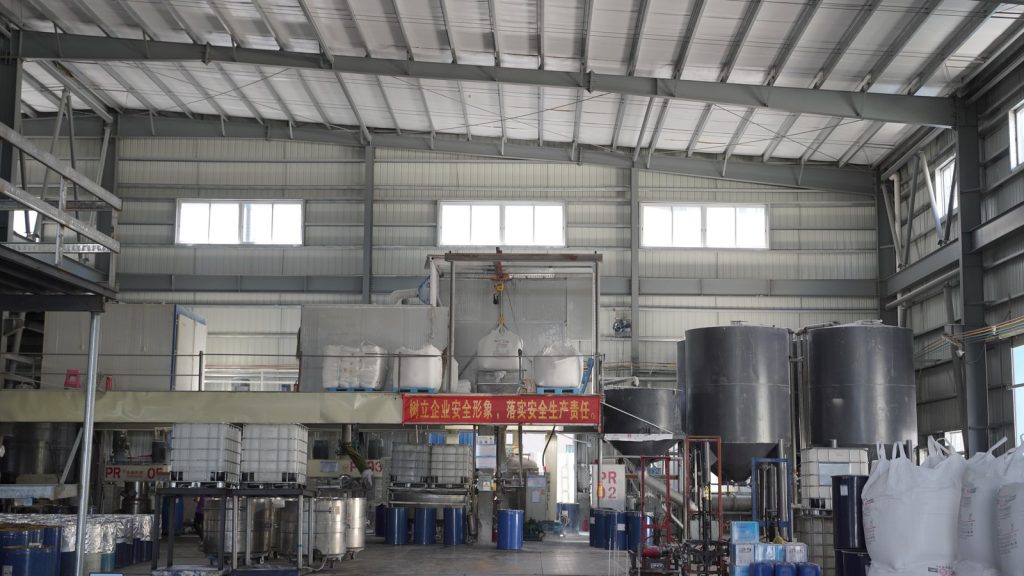
Both product types in this article are manufactured to GB/T 14683-2017, with the structural grade tested to GB 16776-2025 and the sanitary grade to JC/T 885-2016. The factory holds ISO 9001:2015 valid to 2029-01-25. If your specification mixes sealant and adhesive in adjacent joints, tell us — the two must be chemically compatible, and we will confirm that before quoting.
Ordering reference
| Commercial term | What PIROI offers |
|---|---|
| MOQ | OEM & private label from 1,000 pcs per model |
| Trial order | Mixed-model trial orders from 3,000 pcs total; stock items from 500 pcs |
| Lead time | Typically 15–25 days after artwork and sample approval |
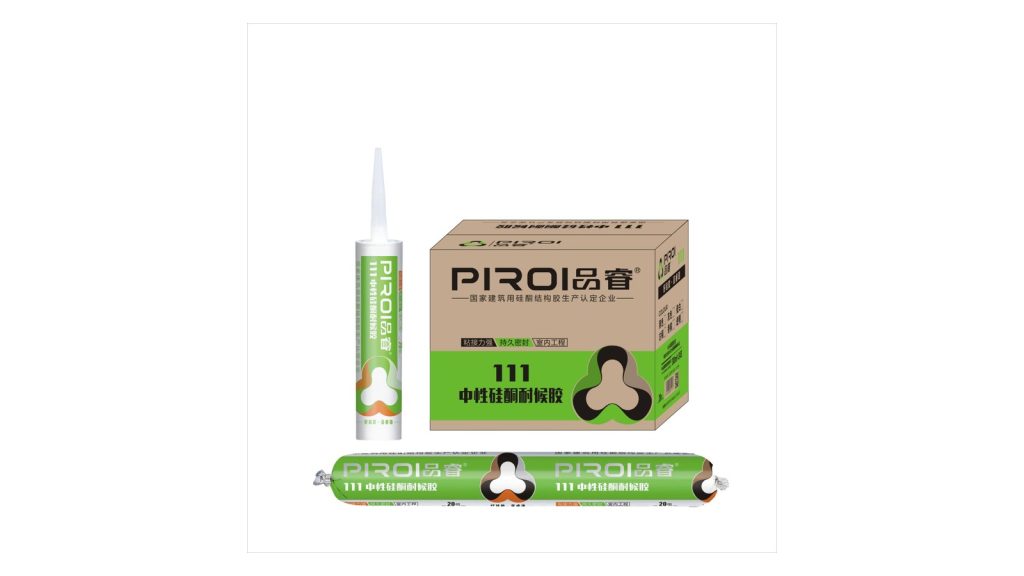
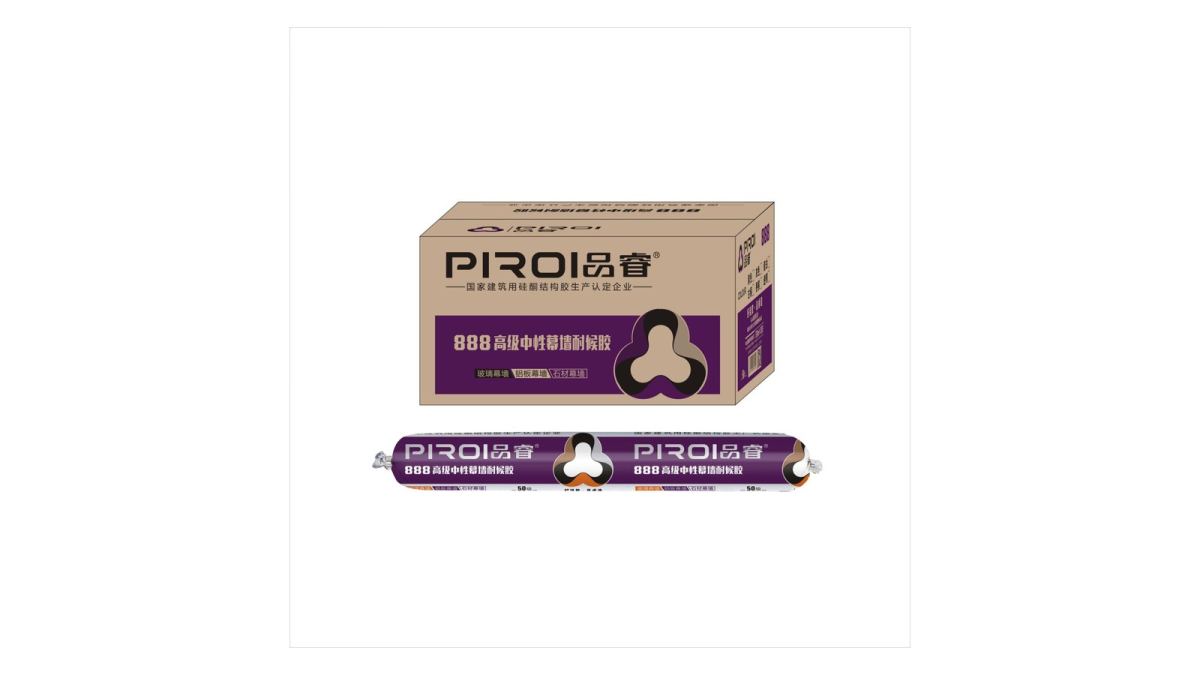
| Packaging | 300 mL cartridges and 590 mL foil sausage packs |
| Private label | Custom cartridge artwork and colour matching supported |
| Sample | Free substrate adhesion and staining test on your own sample |
Three names for two products: adhesive, caulk and sealant
The same confusion appears under three different phrasings, and all three resolve the same way:
| Phrasing | What the searcher usually means | The answer |
|---|---|---|
| Silicone adhesive vs silicone caulk | “Caulk” is the trade word for a gap filler; “adhesive” implies holding | Caulk is a sealant by function — it fills and seals a joint. An adhesive carries load. The chemistry can be identical; the function is not. |
| Silicone glue vs silicone sealant | “Glue” is the consumer word for anything that sticks | Glue implies a bonded assembly. A sealant is specified to move, not to hold. Reading the movement class settles which one you have. |
| Adhesive vs sealant | General comparison | Sealant = designed to move; adhesive = designed to hold. Modulus and movement capability are the numbers that separate them. |
One practical test avoids the whole vocabulary problem: look at what the datasheet reports. A product quoted mainly on movement class, elastic recovery and elongation is a sealant. A product quoted mainly on tensile strength and lap shear is an adhesive. If a datasheet reports both without saying which position it is for, ask the supplier — the answer changes what you should buy.
The same question arrives in three wordings, and all three resolve to the same test: silicone adhesive vs silicone caulk is a comparison of function, not chemistry, because caulk is the trade word for a gap filler; silicone glue vs silicone sealant is the consumer version of the same confusion, where “glue” implies a bonded assembly; and adhesive versus sealant is the general form. In each case the datasheet tells you which product you have: movement class and recovery mean sealant, tensile strength and lap shear mean adhesive.