
What Did GB 16776-2025 Change for Structural Silicone Sealant Buyers?
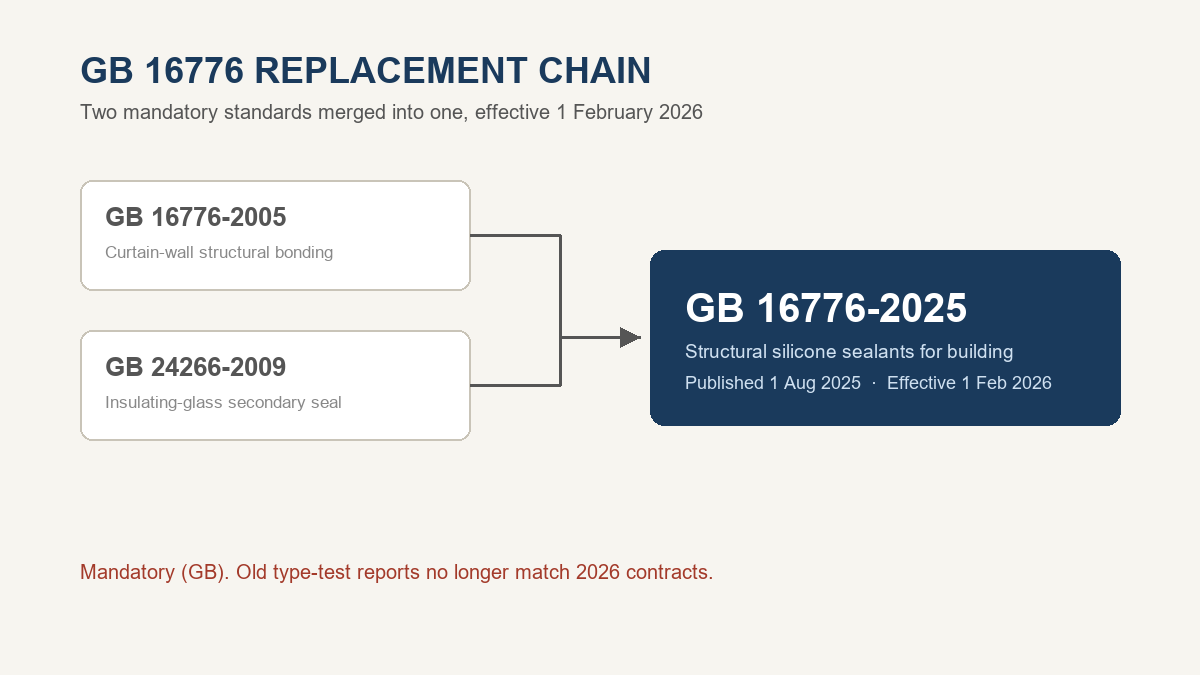
If you import structural silicone sealant from China, the standard cited on your supplier’s test report changed on 1 February 2026. GB 16776-2025, Structural silicone sealants for building, replaced the 2005 edition and absorbed GB 24266-2009 into a single mandatory text. A type-test report issued against the old editions no longer describes the product a 2026 contract requires. This guide sets out what changed in the test programme, which documents to require, and how a current report — ours, Report No. 2025ML009 for PR-999 — reads against the new edition.
- GB 16776-2025 took effect on 1 February 2026, fully replacing GB 16776-2005 and GB 24266-2009.
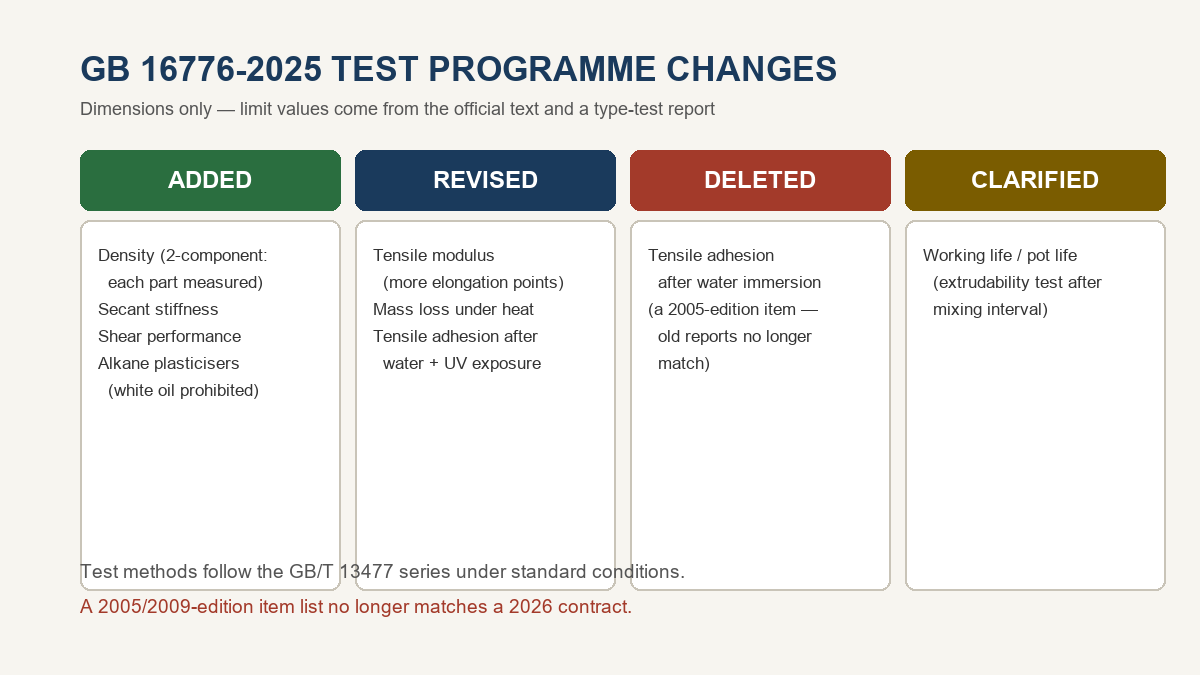
- The test programme changed: density, secant stiffness, shear performance and an alkane-plasticiser prohibition were added; tensile modulus, heat mass loss and water/UV adhesion requirements were revised; tensile adhesion after water immersion was deleted.
- Insulating-glass secondary sealing now sits under the same standard as curtain-wall structural bonding, classified by intended use.
- Importers should require a type-test report issued against GB 16776-2025, with the intended-use class, component count and substrates matching the order.
1. Two Standards Become One
Before February 2026, Chinese structural sealants sat under two separate mandatory standards: GB 16776-2005 for curtain-wall structural bonding and GB 24266-2009 for the secondary edge seal of insulating glass units. The 2025 edition merges both regimes into one standard and classifies products by intended use.
| Item | Detail |
|---|---|
| Standard and title | GB 16776-2025, Structural silicone sealants for building |
| Nature | Mandatory national standard (GB, not the recommended GB/T) |
| Published | 1 August 2025 |
| Effective | 1 February 2026 |
| Replaces | GB 16776-2005 and GB 24266-2009 |
| Issued by | SAMR and SAC; proposed by the Ministry of Industry and Information Technology |
Two details are easy to miss. First, the revision moves the standard from clause-level mandatory to mandatory in its entirety, so the technical requirements carry mandatory force as a whole. Second, a purchase order that only says “structural silicone sealant” is now incomplete: the classification distinguishes curtain-wall structural bonding from insulating-glass secondary sealing, single-component from two-component, and substrate types. State the intended-use class, the component count and the substrates in the enquiry.
2. What Changed in the Test Programme
The revision changed both the physical-property requirements and the engineering-application requirements. The table below lists the dimensions only. Limit values belong to the official standard text and a type-test report — quick-reference tables copied around the internet contradict one another and should not be used as acceptance criteria.
| Change | Item | What it means for a buyer |
|---|---|---|
| Added | Density | For two-component products, each component is measured separately; the report should show this |
| Added | Secant stiffness | Resistance to deformation under early load; a reference for design and selection |
| Added | Shear performance | A new mechanical dimension the report must cover |
| Added | Alkane plasticisers | White oil and similar alkane plasticisers are explicitly prohibited, closing a known compatibility failure mode |
| Revised | Tensile modulus | Test points added at several elongations; one former high-elongation point removed |
| Revised | Mass loss under heat; tensile adhesion after water and UV exposure | Both the requirement and the test method changed |
| Deleted | Tensile adhesion after water immersion | A 2005-edition item; old reports carry an item set that no longer matches |
| Clarified | Working life / pot life | Defined by an extrudability test after a stated interval following mixing of two-component material |
Test methods largely follow the GB/T 13477 series for building sealants under standard temperature and humidity conditions. The practical takeaway is blunt: a report with a complete 2005- or 2009-edition item list no longer matches a 2026 contract, because the item set itself changed. Ask for a type-test report issued against the new edition and still within its validity period.
3. What to Require from Your Supplier in 2026
- A type-test report against GB 16776-2025. Check that the intended-use class, component count and substrates match your order, and that the report carries the relevant accreditation marks.
- Compatibility and peel-adhesion reports covering the actual materials the sealant will contact — coated glass, anodised or powder-coated aluminium, backer rod, spacers — issued by a qualified laboratory.
- Batch documents: certificate and factory inspection report, with batch number, production date and shelf life matching the delivered batch.
- Incoming re-test records for Shore hardness and standard-condition tensile adhesion; for two-component products, mixing-uniformity and snap-time records before application.
- Movement-capability data in writing, against your calculated joint movement — not a catalogue claim.
For how the individual fields on such a report read, see our guide to reading a silicone sealant TDS, and for the three-temperature tensile adhesion regime see our structural sealant test-report walkthrough.
4. A Current Report Reads Like This: PR-999
PR-999, our one-component neutral-cure structural silicone, is tested to GB 16776-2025 under Report No. 2025ML009. The published values below show what a buyer should expect to see on a current report — including items that did not exist on a 2005-edition report, such as shear performance.
| Property | PR-999 published value |
|---|---|
| Tensile adhesion strength (23°C) | 0.85 MPa (standard minimum 0.60) |
| Tensile adhesion strength (90°C) | 0.71 MPa (minimum 0.45) |
| Tensile adhesion strength (−30°C) | 1.44 MPa (minimum 0.45) |
| Elongation at maximum tensile strength | 205% (minimum 100) |
| Shear strength | 0.89 MPa |
| Tensile adhesion after water / UV exposure | 0.93 MPa |
| Shore A hardness | 41 (range 20–60) |
The three-temperature tensile adhesion requirement is the core of the standard: a structural joint in a curtain wall carries wind load and panel weight for the life of the building, so the adhesive must hold at desert heat, winter cold and after water immersion and UV exposure through the glass. A report that passes only the 23°C point does not describe a structural grade.
5. Frequently Asked Questions
Can we still accept a 2005-edition report for a contract signed before February 2026?
At product level the new edition applies from 1 February 2026, and acceptance criteria follow the current mandatory standard. For legacy projects, obtain written confirmation from the project designer rather than carrying an old report forward. For any new order, require the new edition.
Does GB 16776-2025 apply to weatherproof sealant?
No. Weatherproof and construction-joint sealants are non-structural and governed by the recommended standard GB/T 14683-2017. A structural sealant carries load; a weatherproof bead absorbs movement and keeps water out. The two are not interchangeable in either direction, and substituting one for the other is a specification error, not a saving.
How do we verify a supplier’s report is genuine?
Check the report number with the issuing laboratory, confirm the standard edition on the report is 2025, and match the intended-use class, component count and substrates to your order. Every model on our specifications page carries a report number that can be verified with the issuing laboratory, and we supply samples for adhesion and compatibility trials before a first order.
6. Ordering Structural Sealant to the New Standard
When you send an enquiry, include the intended-use class (curtain-wall structural bonding or insulating-glass secondary sealing), the joint dimensions and calculated movement, the substrates and finishes, the packaging format (300 mL cartridge or 590 mL sausage) and whether OEM or private-label printing is required. Standard OEM and private-label MOQ is 1,000 pcs per model, with mixed-model trial orders from 3,000 pcs total and stock items from 500 pcs. Samples for adhesion and compatibility testing ship before production, and the full 17-model range with density, tack-free time, extrusion rate and modulus is listed on our specifications page.