
How to Read a Silicone Sealant TDS: Every Field Explained
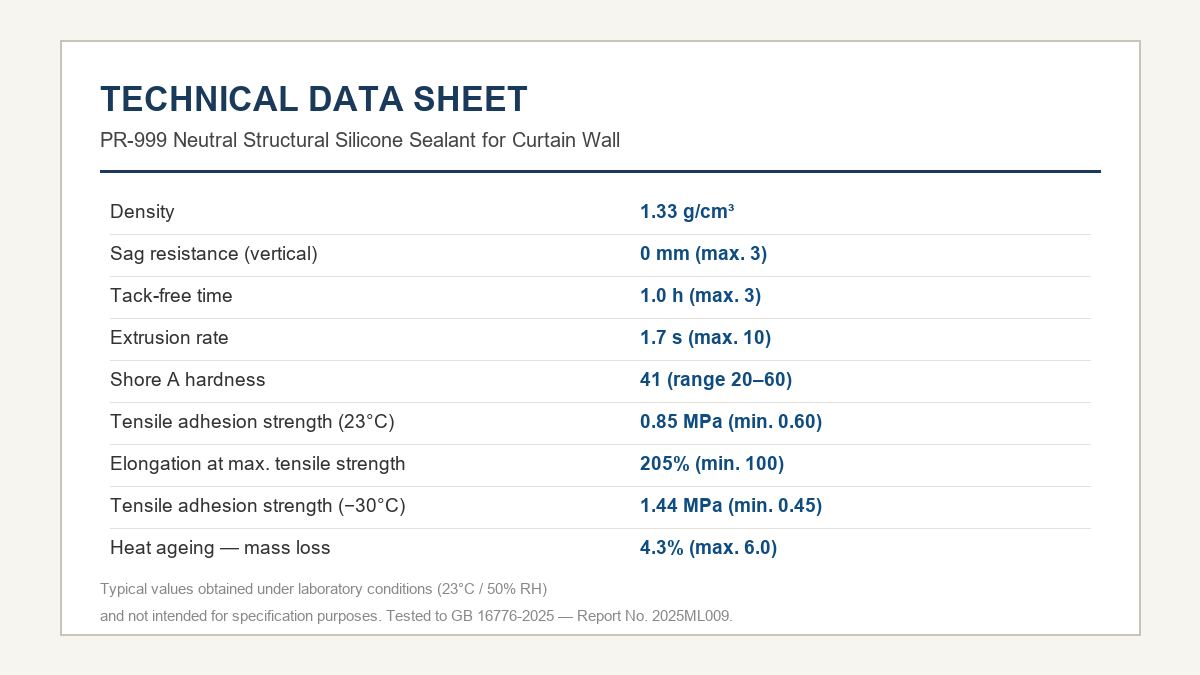
A silicone sealant TDS — technical data sheet — is the single document that decides whether a grade fits your joint. Most buyers skim it for a price and a cure time, and miss the two fields that cause most site failures: tensile adhesion after environmental exposure, and movement capability. This guide reads a real TDS field by field, using numbers from our PR-999 report (GB 16776-2025, Report No. 2025ML009) so every value below is one you can check against the published sheet.
- Identity block — model, cure chemistry, packaging, shelf life
- Application fields — density, sag resistance, tack-free time, extrusion rate
- Mechanical fields — hardness, tensile adhesion at three temperatures, elongation, shear
- Classification line — the movement class that goes into the joint calculation
- The disclaimer — why “typical values” is not the same as a guarantee
The identity block: what product, in what state
Read the top of the sheet before any number. The model code (PR-999), the cure system (neutral cure), the packaging (590 mL sausage) and the shelf life (12 months) are four separate facts that travel together. A TDS for a different model in the same series — or the same model in an old revision — is a different document. If the sheet does not carry a report number and a revision date, ask for them; a silicone sealant TDS without a traceable report is a brochure.
Application fields: what the sealant does before it cures
Four fields describe the uncured behaviour, and each has a pass mark from the standard.
- Density — 1.33 g/cm³. Converts cartons into kilograms for shipping and costing. A 590 mL sausage at 1.33 g/cm³ is roughly 785 g of sealant.
- Sag resistance — 0 mm (max. 3). On a vertical joint, the sealant must not slump. The pass mark is 3 mm; this grade measures zero.
- Tack-free time — 1.0 h (max. 3). When the surface stops accepting dust. Cold weather stretches it — see our note on cold weather application limits.
- Extrusion rate — 1.7 s (max. 10). How fast the sealant leaves the nozzle. Lower is faster; site crews feel this one directly.
Mechanical fields: what the cured joint can carry
These are the numbers a structural engineer specifies against, and each is quoted with its pass mark from GB 16776-2025.
- Shore A hardness — 41 (range 20–60). How the cured bead feels; the range spans the standard’s whole grade band.
- Tensile adhesion strength at 23°C — 0.85 MPa (min. 0.60). The reference value.
- Tensile adhesion at 90°C — 0.71 MPa (min. 0.45). Heat is the first derating a facade sees.
- Tensile adhesion at −30°C — 1.44 MPa (min. 0.45). Cold makes the joint stronger but stiffer — the failure mode moves, it does not vanish.
- Tensile adhesion after water and UV exposure — 0.93 MPa (min. 0.45). The field that predicts the tenth year, not the first day.
- Elongation at maximum tensile strength — 205% (min. 100). How far the joint stretches before the bond gives.
- Shear strength — 0.89 MPa (min. 0.60). The load direction a curtain wall actually applies.
- Heat ageing — mass loss 4.3% (max. 6.0), no cracking or chalking. What evaporates out of the cured bead over time.
Moving between two TDSs without mixing them up
Comparisons go wrong when the two sheets describe different objects, versions or conditions. Before putting two grades side by side, confirm three things: same model and configuration, same standard edition, same test conditions. A 0.85 MPa at 23°C and a 0.71 MPa at 90°C are not a contradiction — they are the same joint at two temperatures.
| Field | PR-999 (structural) | PR-520 (weatherseal) | PR-888 (weatherseal) |
|---|---|---|---|
| Standard | GB 16776-2025 | GB/T 14683-2017 | GB/T 14683-2017 |
| Report No. | 2025ML009 | 2024ME302 | 2022MF117 |
| Tack-free time | 1.0 h | 0.8 h | — |
| Tensile adhesion (23°C) | 0.85 MPa | 0.8 MPa modulus | — |
| Shore A hardness | 41 | — | — |
| Classification | SR-I-F-25HM | SR-I-F-25HM | — |
The dash marks a field the sheet does not state. Leave it a dash — do not copy a value across from a sister product, because the same number on two sheets can still come from two different reports.
Red flags on a silicone sealant TDS
- No report number, or a report number that does not appear on the certificate wall
- Typical values presented without the laboratory-conditions disclaimer
- A standard edition that does not match the certificate (for example a sheet citing a superseded edition)
- Mechanical fields copied between models in the same series
- A “guaranteed” column — TDS values are typical, the guarantee lives in the test report and the warranty
What we ship with the TDS
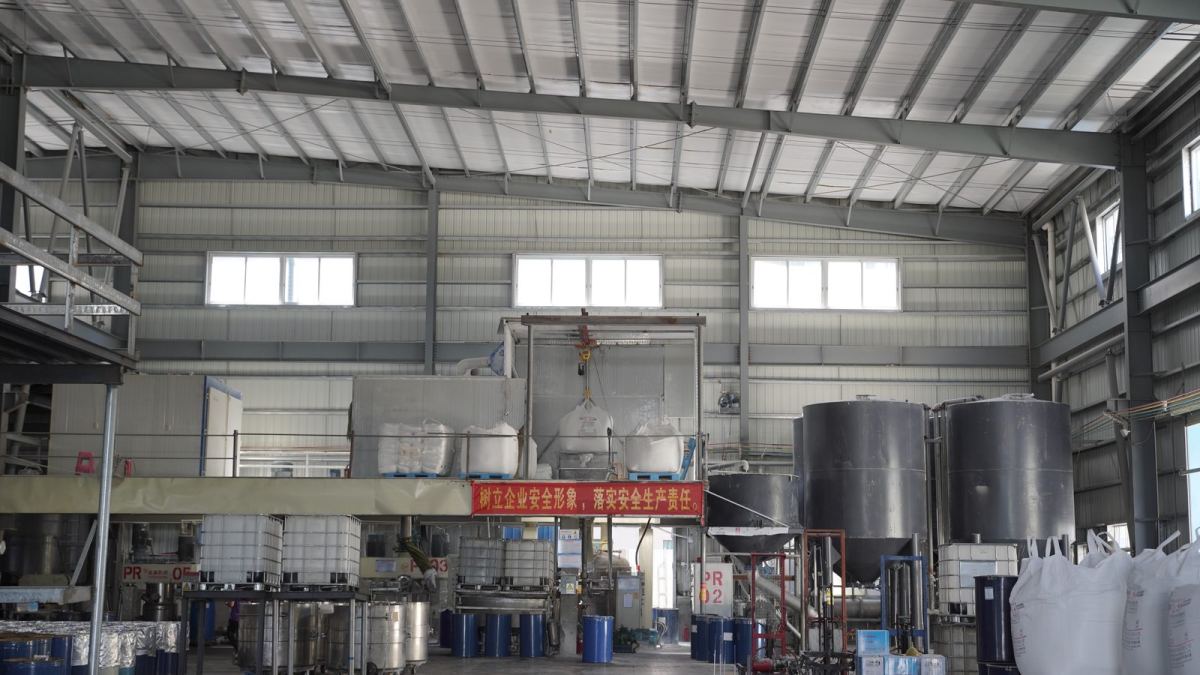
Every PIROI silicone sealant ships with its TDS, the matching test report and the SDS on request. MOQ is 1,000 pcs per model for OEM and private label orders, mixed-model trial orders from 3,000 pcs, and samples go out before the production run. The TDS above is the same sheet our factory QC lab tests against — the report behind it is downloadable from the certifications page, and the field-by-field numbers for each of the 17 models sit on their product pages. If your specification calls for a joint calculation against these values, the joint calculator takes the movement class straight from the classification line.