Key Takeaways for Specifiers and Buyers
- Structural silicone carries load. A weatherseal accommodates movement; a structural sealant transfers wind load from the glass or panel into the frame. The two are governed by different standards and cannot be substituted.
- The governing standard in China is GB 16776-2025. It sets minimum tensile adhesion strength at 23 °C, 90 °C and −30 °C — all three must pass, because curtain wall joints see all three.
- “Alkane plasticizer: not detected” is the single most important line on the report. Plasticizers migrate out of the cured rubber, and migration is a slow-motion adhesion failure that typically appears two to five years after installation.
- Cold performance surprises buyers. Our PR-999 records 1.44 MPa at −30 °C — higher than at room temperature, which is normal for silicone and exactly why the standard requires a cold test.
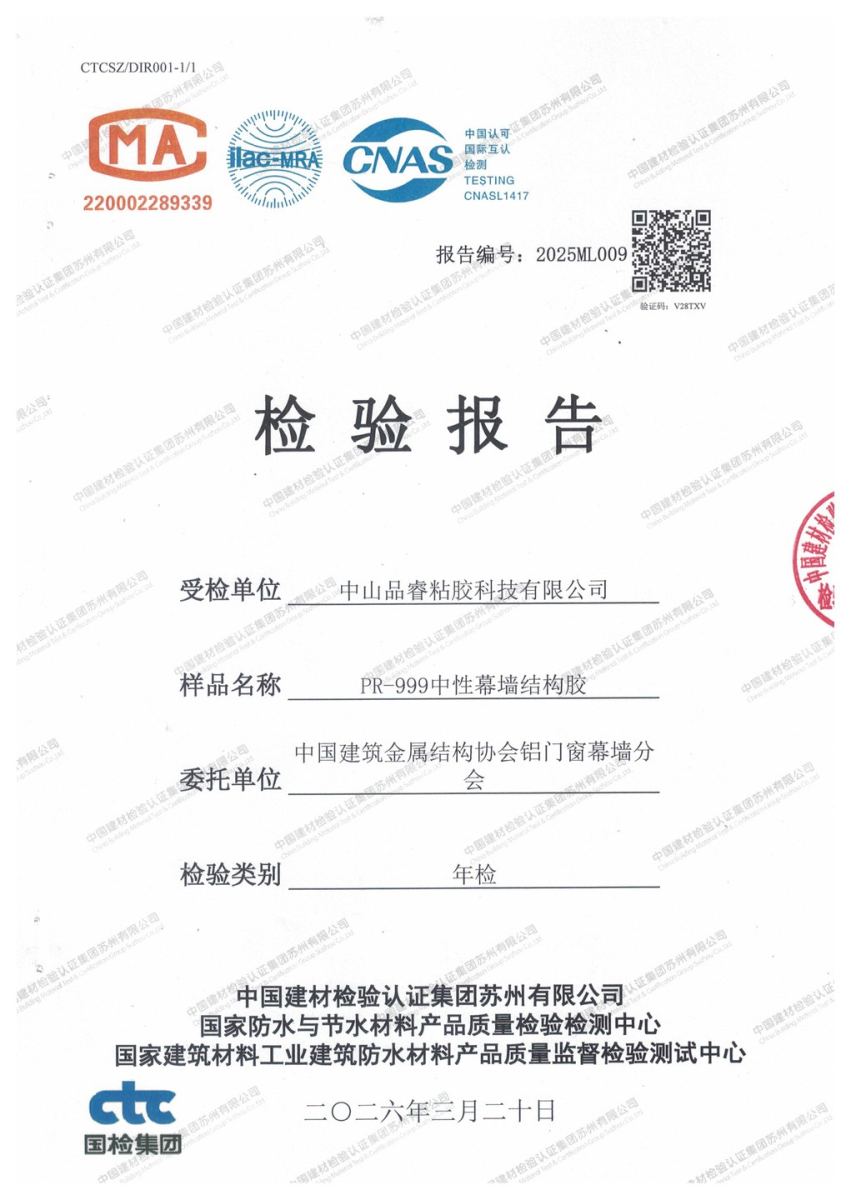
- Ask for the report, not the datasheet. The figures below come from CTC Suzhou report No. 2025ML009 and can be verified independently.
Structural silicone sealant is the one product in the sealant catalogue where a specification error can bring a panel down. That is not a figure of speech: structural silicone is the only element holding a structural glazing panel to its frame on many facades, and it is also the primary weatherseal at the same joint.
Because it is a safety-critical component, structural silicone is one of the few sealants with its own mandatory standard. In China that standard is GB 16776-2025. This guide explains what it requires, which numbers decide fitness for purpose, and how to read a real test report.
1. Structural vs Weatherseal: The Distinction That Matters
Both are silicone sealants. Both are applied to the same joint on a unitised curtain wall. They are not interchangeable.
| Property | Weatherseal | Structural sealant |
|---|---|---|
| Function | Seal out water and air; accommodate movement | Transfer wind and dead load from panel to frame; also seal |
| Governing standard | GB/T 14683-2017 (and equivalents) | GB 16776-2025 — mandatory |
| Tensile adhesion at 23 °C | Type M / Type G classification | min. 0.60 MPa |
| Temperature range tested | Normally room temperature | 23 °C, 90 °C and −30 °C |
| Plasticizer check | Not routinely required | Alkane plasticizer must be absent |
| Joint design | Width : depth ratio, movement capability | Bite, glass stress, load calculation per project |
The practical rule: if the sealant is on the load path — if removing it would let the panel move — it is structural, and GB 16776 applies. If it is filling a joint between two panels that are already mechanically fixed, it is a weatherseal.
2. What GB 16776-2025 Actually Requires
GB 16776-2025 (Silicone structural sealant for building) is not a marketing scheme. It sets pass/fail limits, and a product either meets them or does not. The requirements fall into four groups:
- Mechanical performance — tensile adhesion strength at three temperatures, elongation at maximum tensile strength, shear strength.
- Durability — heat ageing with limits on mass loss and on cracking or chalking; adhesion retained after water and UV exposure.
- Formulation integrity — the alkane plasticizer check, which exists specifically to exclude a known failure mode.
- Workability — extrusion rate, tack-free time, sag resistance, hardness.
All of these appear on a compliant test report. A datasheet that quotes only the room-temperature tensile figure is not evidence of compliance — it is marketing.

3. The Numbers That Decide Fitness for Purpose
The table below is the actual test data for PIROI PR-999, a one-component neutral-cure structural sealant for glass, aluminium panel and terracotta curtain walls, tested under GB 16776-2025.
| Test item | GB 16776 requirement | PR-999 result |
|---|---|---|
| Tensile adhesion strength, 23 °C | min. 0.60 MPa | 0.85 MPa |
| Tensile adhesion strength, 90 °C | min. 0.45 MPa | 0.71 MPa |
| Tensile adhesion strength, −30 °C | min. 0.45 MPa | 1.44 MPa |
| Tensile adhesion after water / UV exposure | min. 0.45 MPa | 0.93 MPa |
| Elongation at max. tensile strength | min. 100% | 205% |
| Shear strength | min. 0.60 MPa | 0.89 MPa |
| Alkane plasticizer | must not be present | Not detected |
| Heat ageing — mass loss | max. 6.0% | 4.3% |
| Heat ageing — cracking / chalking | None | None |
| Density | — | 1.33 g/cm³ |
| Shore A hardness | 20–60 | 41 |
| Sag resistance (vertical) | max. 3 mm | 0 mm |
| Tack-free time | max. 3 h | 1.0 h |
| Extrusion rate | max. 10 s | 1.7 s |
4. Why the Cold Number Is Higher Than the Warm One
Buyers regularly query the −30 °C figure of 1.44 MPa. It is higher than the 0.85 MPa measured at 23 °C, which looks like an error to anyone expecting performance to degrade in the cold.
It is not an error. Silicone rubber stiffens as it cools. Below its glass transition temperature the polymer chains lose mobility, so the material becomes harder and its measured strength rises. That is precisely why the standard requires a cold test: it is not checking whether the sealant gets weaker, it is checking whether it becomes brittle. A sealant that hardens into a glassy, crack-prone solid at −30 °C will fail by cohesive fracture, not by low strength.
The 205% elongation figure is the counterweight. It confirms the cured rubber still stretches to more than twice its original length before breaking, so the joint can absorb thermal movement across the full service range without the sealant itself becoming the weak point.
5. “Alkane Plasticizer: Not Detected” — The Line Most Buyers Skip
This is the single most consequential line on the report, and it is the one most often ignored because it reads like a negative result.
Alkane plasticizers — sometimes called white oil or paraffin oil — are added to cheap sealant formulations to reduce cost and soften the compound. They do make the uncured product easier to gun and they do pass a short-term adhesion test. The problem is what happens next.
Plasticizer is not chemically bound into the silicone network. Over months and years it migrates to the surface and into the substrate. The consequences are cumulative and largely irreversible:
- Loss of adhesion. The migrating oil creates a boundary layer between the sealant and the glass or aluminium, and the bond eventually releases — often at the worst possible moment, under wind load.
- Staining. The exuded oil collects dust and darkens the joint line and the adjacent panel edge.
- Shrinkage. As plasticizer leaves, the sealant loses volume, which opens the bond line and accelerates water ingress.
- Failure without warning. Unlike a cracked sealant, a plasticizer failure is often invisible until the panel moves.
For a weatherseal the risk is cosmetic. For a structural bond it is a safety issue, which is why GB 16776 screens for it explicitly. “Not detected” is the result you want, and it should be stated on the report rather than assumed from the formulation.
6. Reading the Rest of a Real Report
The figures above come from CTC Suzhou report No. 2025ML009 for PIROI PR-999. When you receive a comparable report, four things are worth checking beyond the headline numbers.
Does the report name the actual product and batch?
A valid structural sealant report identifies the model and the sampled batch. A generic report covering “silicone sealant” without a model number cannot support a structural specification.
Is the laboratory accredited for the test?
Look for CNAS / CMA accreditation marks and the laboratory’s registration numbers on the cover page. Both appear on the CTC Suzhou report and can be verified through the CNAS website using the report number.
Are all three temperatures present?
A report showing only 23 °C is incomplete for structural purposes. The 90 °C and −30 °C results are what separate a structural product from a general-purpose one.
Is the water / UV exposure result there?
This is the durability check. A structural bond on an exterior facade will be rained on and UV-exposed for its entire life, and adhesion after both is the figure that predicts long-term behaviour. PR-999 records 0.93 MPa after water and UV exposure, against a 0.45 MPa minimum.
7. How to Specify Structural Silicone Correctly
Four steps, in this order:
- Confirm the sealant is on the load path. If it is, GB 16776 applies and the product must be classified to it. There is no “equivalent” shortcut for a safety-critical bond.
- Size the bite and joint from the load. Structural silicone design starts from wind load and panel dimensions, not from the sealant’s datasheet. The joint geometry comes first; the sealant is then selected to suit it.
- Verify compatibility with the actual substrates and finishes. Adhesion depends on the specific glass coating, anodising or powder coating on the project. This is normally confirmed by an adhesion test on project samples before installation.
- Require the report at tender stage. Ask for the classification, the three temperature figures and the plasticizer result. Suppliers who have tested will answer immediately; suppliers who have not will send a datasheet.
Frequently Asked Questions
Can I use a weatherseal sealant as a structural sealant?
No. A weatherseal is designed to move, not to carry load, and it has not been tested at 90 °C or −30 °C or screened for alkane plasticizer. Using one on the load path is a safety failure, not a cost saving.
Why does my supplier’s structural sealant have no cold-temperature figure?
Because it has not been tested to a structural standard. GB 16776 requires tensile adhesion at 23 °C, 90 °C and −30 °C; a report missing any of the three does not demonstrate compliance.
Is higher tensile strength always better?
No. Structural silicone needs a balance: enough strength to carry the design load, and enough elongation to accommodate movement without cracking. A very high-modulus product can be too stiff for the joint it is installed in. PR-999 combines 0.85 MPa at 23 °C with 205% elongation, which is the combination that matters.
What does “neutral cure” mean here, and does it matter?
Neutral-cure silicones release alcohol or oxime during cure rather than acetic acid. Acetic acid can corrode metal substrates and attack mirror backing, and the smell is noticeable in enclosed spaces. For structural glazing on aluminium and for mirror or stone work, neutral cure is the appropriate choice.
How is PR-999 packaged?
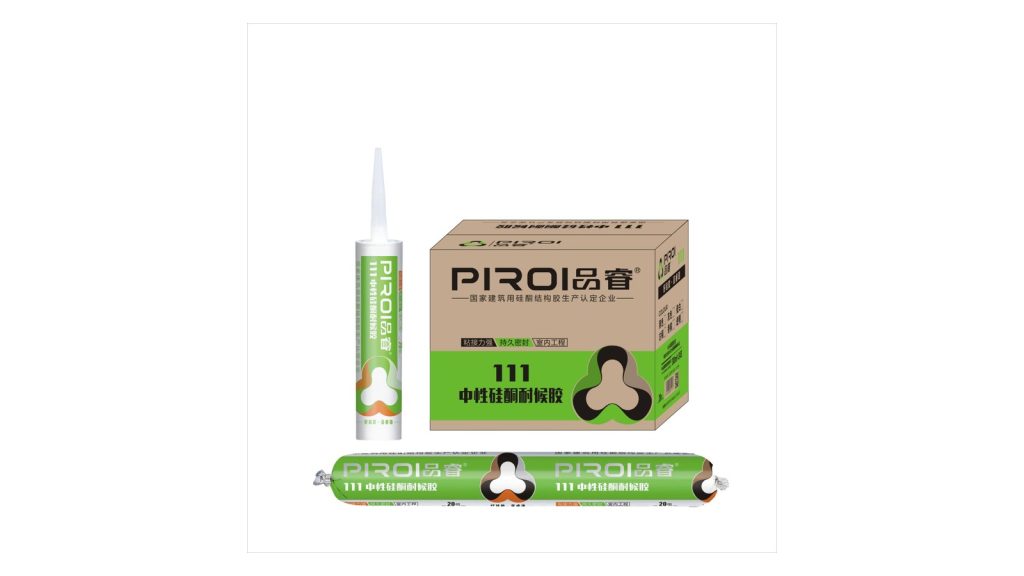
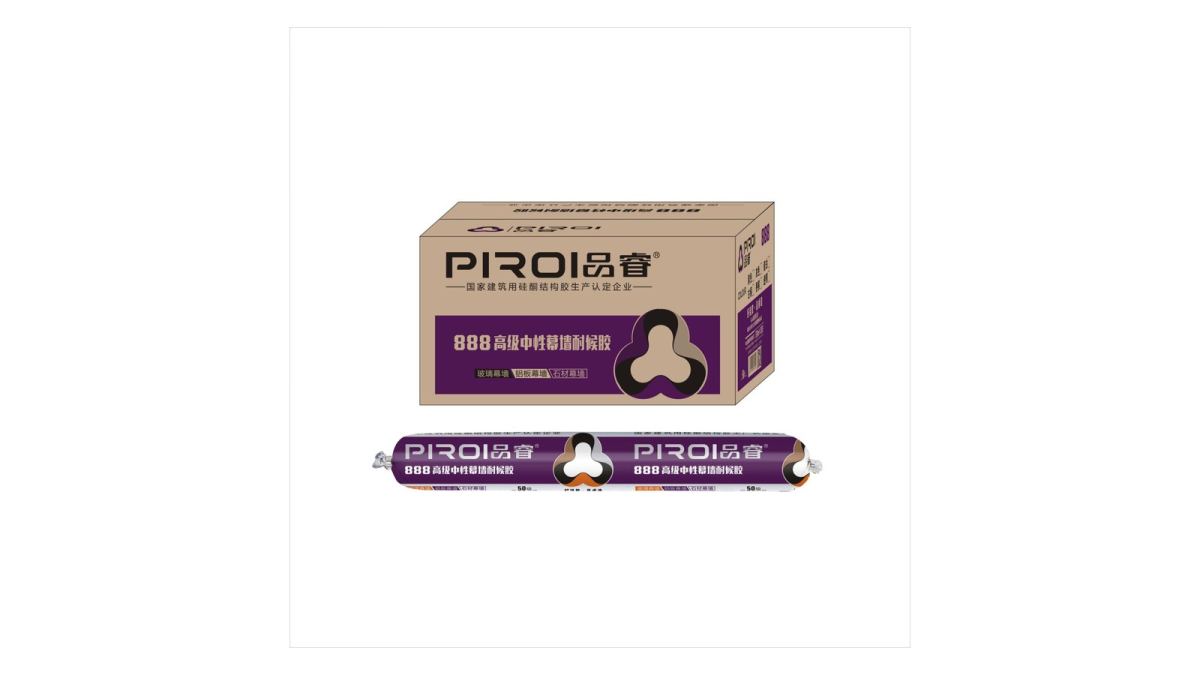
PR-999 is supplied in 590 mL sausage packs, the format normally used with bulk dispensing equipment on curtain wall assembly lines. Shelf life is 12 months.
Can I get the test report?
Yes. Specifiers, facade consultants and contractors can request the GB 16776-2025 test report for PR-999 — CTC Suzhou report No. 2025ML009 — together with the TDS and safety documentation, through our contact page.
Substrates, Curtain Wall Test Data and Ordering Reference
Curtain wall work splits into a structural position and a weatherseal position, and the two are tested against different standards. This section maps substrates to positions, reproduces the numbers from the structural test report, and sets out the commercial terms.
Substrates and joints this applies to
| Substrate | Suitability | What to watch |
|---|---|---|
| Glass (structural and weatherseal) | Two grades required | Structural carries wind load; weatherseal keeps water out |
| Anodised aluminium mullions | Neutral cure only | Acid cure etches the anodised layer |
| Aluminium composite panel (ACP) | Neutral cure only | Coating compatibility must be confirmed |
| Precast concrete panels | Neutral cure only | Alkaline substrate rejects acid cure |
| Natural stone and terracotta | Neutral cure only | Acid reacts with calcium carbonate and stains |
| Stainless steel fixings and profiles | Neutral cure preferred | Adhesion proved on the actual finish |
| Ceramic and glazed panels | Neutral cure | Check movement before selecting Class 25 or 50 |
| UPVC and PVC profiles | Neutral cure only | Protects the steel reinforcement in the chamber |
Performance data you can quote in a submittal
| Property | Tested value | Requirement |
|---|---|---|
| Product standard (structural) | GB 16776-2025 | Structural silicone sealant standard |
| Tensile adhesion strength (23 °C) | 0.85 MPa | Minimum 0.60 MPa |
| Tensile adhesion strength (90 °C) | 0.71 MPa | Minimum 0.45 MPa |
| Tensile adhesion strength (−30 °C) | 1.44 MPa | Minimum 0.45 MPa |
| After water / UV exposure | 0.93 MPa | Minimum 0.45 MPa |
| Elongation at max. tensile strength | 205% | Minimum 100% |
| Shear strength | 0.89 MPa | Minimum 0.60 MPa |
| Alkane plasticizer | Not detected | Must not be detected |
What the cure chemistry does inside the joint
A neutral-cure silicone is a one-component RTV system: it crosslinks by reacting with atmospheric moisture, starting at the surface and working inward. The by-product is an alcohol or an oxime rather than acetic acid, which is why neutral grades can be used against concrete, mortar, natural stone, marble, anodised aluminium and the metal reinforcement inside a PVC profile without etching or staining the substrate. Cure depth is roughly 2–4 mm in the first 24 hours at 23 °C and 50% RH; a 6 mm joint therefore needs several days before it carries load, and a joint that is sealed and immediately loaded will fail at the interface rather than in the sealant.
Standards and documentation
The structural grade is tested to GB 16776-2025 by CTC Suzhou, and the weatherseal grades to GB/T 14683-2017. We do not claim ASTM C920 certification for either; if your facade specification calls for ASTM, tell us at enquiry stage so we can confirm what is and is not available. The factory holds ISO 9001:2015 valid to 2029-01-25, and the 2026 annual inspection listing from the China Building Metal Structure Association covers PR-999.
Ordering reference
| Commercial term | What PIROI offers |
|---|---|
| MOQ | OEM & private label from 1,000 pcs per model |
| Trial order | Mixed-model trial orders from 3,000 pcs total; stock items from 500 pcs |
| Lead time | Typically 15–25 days after artwork and sample approval |
| Packaging | 300 mL cartridges and 590 mL foil sausage packs |
| Private label | Custom cartridge artwork and colour matching supported |
| Sample | Free substrate adhesion and staining test on your own sample |
Deglazing inspection: what to look for before a panel fails
Deglazing in the maintenance sense means removing a panel to inspect or replace the structural bond behind it — the sealant that carries the glass. It is done when the bond is suspected of having deteriorated, and the decision to deglaze one panel or a whole elevation rests on what an inspection finds first.
A practical inspection sequence, cheapest first:
- Visual survey from outside and inside. Look for a bead that has pulled away at the edge, changed colour unevenly, or shows a line of dirt along the bond — dirt tracking into a gap means water is already there.
- Probe the exposed edge. Where the bead is accessible, a blunt probe reveals whether the bond is still adhered or has lifted. Do not use a sharp tool, which can start a tear that was not there.
- Check the weatherseal first. Most water ingress blamed on structural silicone is a failed weatherseal joint letting water behind the panel. Repairing the weatherseal is far cheaper than deglazing.
- Sample-test a panel. Where the bond is genuinely suspect, deglaze one representative panel and inspect the bond face. Adhesive failure across the whole face means the bond was never right; cohesive tearing means the bead has been overloaded.
- Record and compare. A photograph and a date per panel turns a one-off inspection into a trend, which is what makes a repair programme defensible to a building owner.
The test report values in this guide are what tells you whether a new bead will carry load as designed. For existing buildings, the same figures are the benchmark an inspection is measured against — a bead that was specified at 0.85 MPa tensile adhesion and now lifts under a probe has lost the property the specification relied on.