Key Takeaways for ASEAN Importers
- FORM E is the ASEAN–China Free Trade Area (ACFTA) preferential certificate of origin. It is issued by a government authority in China, not by the supplier.
- A valid FORM E can reduce import duty to 0% — but only when the destination country’s tariff schedule grants preferential rates to that specific HS code. It is not automatic for every product or every market.
- Duty treatment depends on the destination country and the HS code. Always verify the current rate with your own customs broker before relying on a duty figure in your costing.
- The certificate must be applied for before shipment in most cases. Retroactive issuance is possible in some jurisdictions but adds delay and risk.
- PIROI supplies the documentation set required to apply for FORM E — we do not issue the certificate itself.
- Common causes of rejection at destination: name/address mismatch, HS code discrepancy, and missing or inconsistent invoice references.
1. What FORM E Actually Is
FORM E is the official certificate of origin used under the ASEAN–China Free Trade Area (ACFTA) agreement. It allows importers in the ten ASEAN member states to claim preferential (often zero) import duty on goods originating in China.
Three points are frequently misunderstood by first-time importers:
- It is a government document. FORM E is issued by an authorized body in China — typically a local branch of the China Council for the Promotion of International Trade (CCPIT) or the customs authority. Your supplier applies for it; the supplier cannot print it.
- It is product- and shipment-specific. Each certificate covers one shipment, one consignee, and the goods listed on it. It is not a standing authorization.
- It does not guarantee zero duty. It grants eligibility for preferential treatment. Whether that results in 0% depends on the destination country’s ACFTA tariff schedule and the HS code of the goods.
2. Which Markets Benefit, and By How Much
All ten ASEAN member states participate in ACFTA, but the depth of tariff elimination varies by country and by product category. Normal-track and sensitive-track products may retain a reduced — not zero — rate.
| Market | ACFTA participant | Typical status for adhesives & sealants | What to verify |
|---|---|---|---|
| Vietnam | Yes | Frequently 0% under ACFTA | Current MFN vs ACFTA rate for the exact HS code |
| Thailand | Yes | Frequently 0% under ACFTA | Whether the code sits on the sensitive list |
| Malaysia | Yes | Frequently 0% under ACFTA | Whether the code sits on the sensitive list |
| Indonesia | Yes | Varies; some codes retain duty | Import licence and HS classification requirements |
| Philippines | Yes | Frequently 0% under ACFTA | Bureau of Customs valuation practice |
| Cambodia, Laos, Myanmar | Yes | Frequently 0% under ACFTA | Local issuing and verification procedures |
| Brunei, Singapore | Yes | Duty is already low or zero | Whether ACFTA treatment adds any benefit |
This table describes the general pattern. It is not a duty quotation. Tariff schedules are revised, and the correct rate depends on the exact HS code applied to the goods. Before you build a landed-cost model around a duty figure, confirm the current rate with a licensed customs broker in your own market.

3. The Documentation Set You Need
Applying for FORM E requires the supplier to submit a consistent document set. Any mismatch between documents is the most common reason a claim is rejected at destination. The set normally includes:
- Commercial invoice — consignee name and address, exact product description, quantity, unit price, total value, Incoterms
- Packing list — cartons, pallets, net and gross weight, dimensions
- Bill of lading or airway bill — port of loading, port of discharge, vessel or flight details
- Product specification or TDS — confirms the goods description matches what is being classified
- Test reports — where the destination authority requires conformity evidence
- HS code declaration — agreed in advance between buyer and seller
The single most important discipline is consistency: the consignee name on the FORM E, the invoice, the packing list and the bill of lading must match exactly, character for character. A trading company name on one document and the end-user name on another will trigger a query, and a query at the port means demurrage.
4. The Application Timeline
-
01
Agree the HS code before the order is placed
Classification drives everything downstream. Send your broker the product description, the chemical basis (silicone sealant, one-component, neutral cure, in cartridges), and the intended end use. Get the HS code in writing. Do not leave this to the shipping week.
-
02
Provide exact consignee details at order confirmation
Give the supplier the full legal name, address and tax or registration number of the importing entity — the same entity that will clear the goods. Changing the consignee after the certificate has been issued usually requires cancellation and re-issuance.
-
03
Confirm the FORM E is applied for before shipment
Standard practice is to apply before the vessel departs. Some authorities allow retroactive issuance within a defined window, but the process adds handling time and is not guaranteed. Treat pre-shipment application as the default.
-
04
Check the draft certificate before the originals are couriered
Ask for a scan of the completed certificate before the originals are dispatched. Verify the consignee block, the goods description, the HS code, the invoice number and the quantity. Correcting a scan is fast; correcting a couriered original is not.
-
05
Present the originals with the customs entry
The original certificate, not a copy, must accompany the import declaration. Keep a scanned copy in your own records — you will need it if the authority queries the shipment later.
5. Where Claims Fail
| Failure mode | Typical cause | Prevention |
|---|---|---|
| Certificate rejected as inconsistent | Consignee name differs between FORM E, invoice and B/L | Freeze the consignee details at order confirmation and use them verbatim |
| Preferential rate refused | HS code on the certificate differs from the code on the customs declaration | Agree the code with your broker before ordering; use it everywhere |
| Retroactive claim rejected | Certificate applied for after vessel departure | Apply before shipment; treat retroactive issuance as an exception |
| Shipment held for valuation | Declared value inconsistent with the invoice or with comparable imports | Ensure the commercial invoice value is complete and internally consistent |
| Missing conformity documents | Destination requires test reports or labelling evidence not supplied | Confirm the destination’s conformity requirements at the quotation stage |
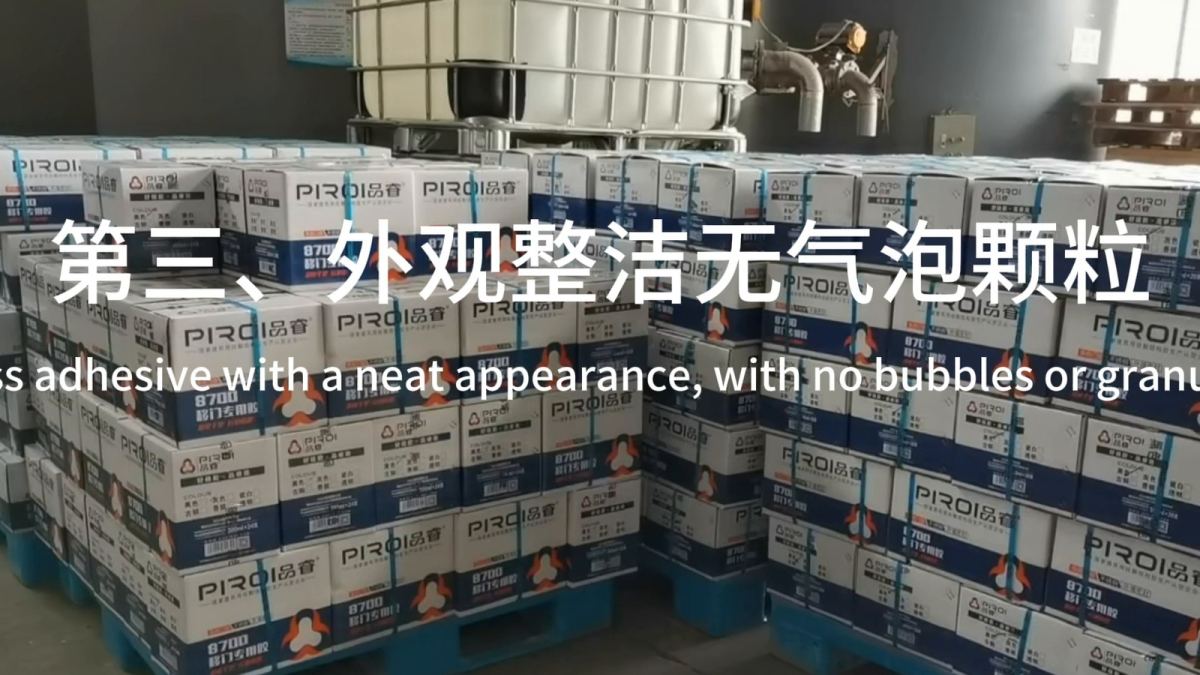
6. What PIROI Provides
PIROI is a silicone sealant manufacturer, not a freight forwarder or a customs broker. What we provide is the document set that lets your forwarder apply for FORM E efficiently:
- Commercial invoice and packing list prepared to the consignee details you supply
- Product description and technical data sheet consistent with the invoice description
- Third-party test reports for the products being shipped
- Coordination with your nominated forwarder or our shipping agent on the certificate application
- Bilingual (English / Chinese) labelling and carton marking where your market requires it
We can also assist with the FORM E application through our export documentation process. We do not issue the certificate, and we do not provide duty advice — that must come from your customs broker in the destination market.
7. Frequently Asked Questions
8. Conclusion
FORM E is one of the most valuable tools available to an ASEAN importer sourcing from China — but it rewards preparation. Agree the HS code early. Freeze the consignee details. Apply before shipment. Check the draft before the originals are couriered. And confirm the actual duty rate in your own market with a licensed broker, rather than assuming that any certificate automatically means zero.
PIROI exports silicone sealants to buyers across Southeast Asia and can prepare the full documentation set for your shipment, including bilingual labelling and test reports. Contact our export team with your destination port and consignee details to discuss documentation requirements for your first order.
Substrates, Batch Data and Ordering Reference for Export Orders
FORM E covers the shipment, but the customs entry still describes a specific product for a specific application. These are the substrates the range is cleared for, the batch data that travels with the certificate, and the commercial terms for a first ASEAN order.
Substrates and joints this applies to
| Substrate | Suitability | What to watch |
|---|---|---|
| Glass and glazing | All grades | Acetoxy or neutral depending on load-bearing duty |
| Window and door frame perimeter joints | Weatherproof grade | Sealing the perimeter between frame and reveal |
| Curtain wall and facade glazing | Structural or weatherseal | Depends on whether the joint carries load |
| Anodised aluminium | Neutral cure only | Acid cure etches the anodised layer |
| Concrete, mortar and render | Neutral cure only | Acid attacks the alkaline substrate |
| Natural stone and marble | Neutral cure only | Acid reacts with calcium carbonate and stains |
| UPVC and PVC profiles | Neutral cure only | Steel reinforcement in the chamber must not see acid |
| Stainless steel and coated metal | Neutral cure preferred | Confirm adhesion on the actual coating |
| Ceramic and sanitary ware | Anti-mould sanitary grade | Wet-area joints need a Grade 0 mould result |
| Timber and engineered board | Neutral cure | Size the joint from the board length and temperature range |
Performance data you can quote in a submittal
| Property | Tested value | Requirement |
|---|---|---|
| Product standard (weatherproof) | GB/T 14683-2017 | Chinese building sealant standard |
| Product standard (structural) | GB 16776-2025 | Structural silicone sealant standard |
| Tensile adhesion strength (23 °C) | 0.85 MPa | Minimum 0.60 MPa |
| Elongation at max. tensile strength | 205% | Minimum 100% |
| Elastic recovery rate | 88–92% | Keeps a moving joint closed |
| Cure system | Neutral cure | No acetic acid released |
| Sag resistance (vertical) | 0 mm | Maximum 3 mm |
| Movement capability | Class 25 and Class 50 available | Sized from the joint demand |
| Shelf life | 12 months from production date | 9 months for acetoxy grades |
| Batch documentation | Certificate of Analysis per batch | Retained sample archived 18 months |
| Packaging | 300 mL cartridge / 590 mL sausage | Bilingual labelling available |
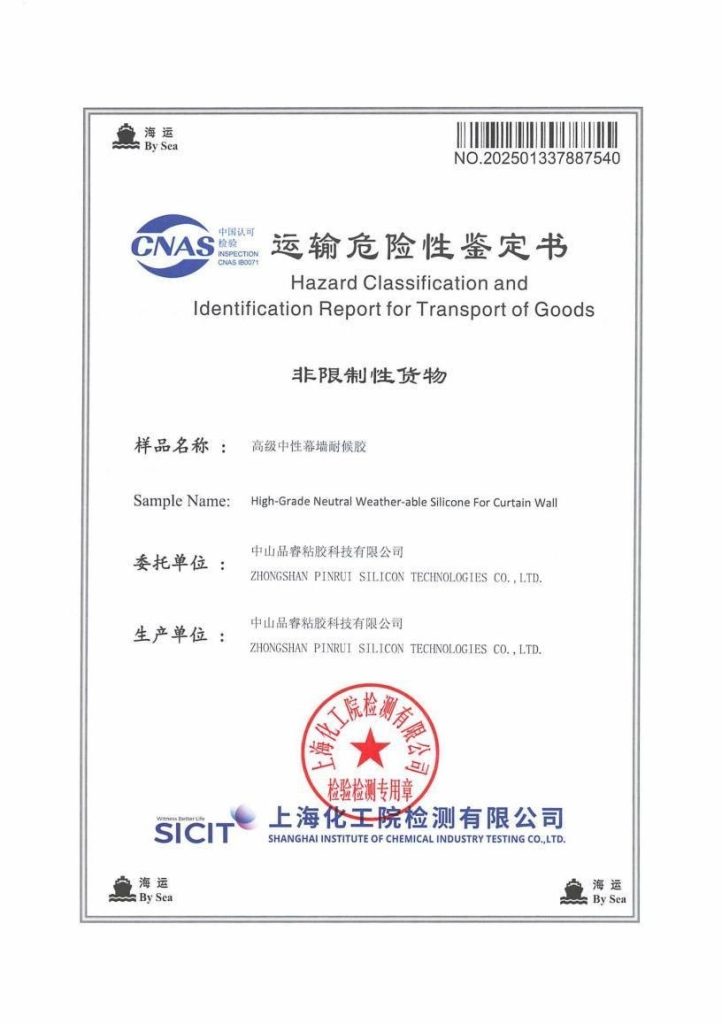
| Transport classification | Non-hazardous goods | Simplifies the customs entry |
What the cure chemistry does inside the joint
A neutral-cure silicone is a one-component RTV system: it crosslinks by reacting with atmospheric moisture, starting at the surface and working inward. The by-product is an alcohol or an oxime rather than acetic acid, which is why neutral grades can be used against concrete, mortar, natural stone, marble, anodised aluminium and the metal reinforcement inside a PVC profile without etching or staining the substrate. Cure depth is roughly 2–4 mm in the first 24 hours at 23 °C and 50% RH; a 6 mm joint therefore needs several days before it carries load, and a joint that is sealed and immediately loaded will fail at the interface rather than in the sealant.
Standards and documentation
Every shipment carries a batch-coded Certificate of Analysis, and the retained sample is archived for 18 months so a customs or buyer query can be answered months after the container has landed. The document set we prepare as standard is FORM E, packing list, COA and third-party test reports; bilingual labelling is available where the destination market requires it.
Ordering reference
| Commercial term | What PIROI offers |
|---|---|
| MOQ | OEM & private label from 1,000 pcs per model |
| Trial order | Mixed-model trial orders from 3,000 pcs total; stock items from 500 pcs |
| Lead time | Typically 15–25 days after artwork and sample approval |
| Packaging | 300 mL cartridges and 590 mL foil sausage packs |
| Private label | Custom cartridge artwork and colour matching supported |
| Sample | Free substrate adhesion and staining test on your own sample |