Window and door sealing is one of the highest-volume uses of a silicone sealant, and one of the places where the wrong product shows up as a production-line problem rather than as a failed joint. A sealant that stays tacky overnight holds up the schedule. A sealant that sags on a vertical transom ruins the panel. A sealant that corrodes an anodised aluminium frame is a recall waiting to happen.

- Cure type. Neutral cure chemistry is required for coated and anodised aluminium profiles and for stainless steel hardware.
- Tack-free time. Factory throughput depends on it — a long cure turns one sealant cartridge into a production bottleneck.
- Sag resistance. Vertical and overhead joints need a sealant with genuine sag resistance, not just a low slump rating.
- Adhesion. Glass, aluminium and stainless steel must stay bonded across thermal cycling, not just at initial application.
- Classification. Transport and storage simplify when the sealant is classified as non-hazardous goods.
What to compare when you buy door and window silicone sealant
| Specification | Why it matters for window and door fabrication | PIROI PR-8800 |
|---|---|---|
| Cure type | Acid cure attacks coated aluminium and metal hardware | Neutral cure |
| Tack-free time | Determines how fast units can be handled and packed | 0.8 h |
| Sag resistance | Vertical transoms and overhead joints | No sagging on vertical and overhead joints |
| Adhesion | Glass, aluminium and stainless steel substrates | Excellent adhesion to glass, aluminium and stainless steel |
| Classification | Shipping and storage handling | Transport as non-hazardous goods |
Why cure type decides the whole application
Acid cure silicone releases acetic acid while curing. On anodised aluminium, powder-coated profiles, stainless steel and some pre-finished substrates, that acid can dull the finish and cause corrosion over time, and it can cause adhesion problems at the interface. Neutral cure silicone has no acidic by-product, so it is the standard choice for window and door fabrication where the substrate inventory includes coated aluminium, stainless steel and glass. That is why most professional window and door silicone sealant specified for factory use is neutral cure.
Tack-free time is a production metric
On a production line, cure time is capacity. If finished units have to wait for the sealant to skin over before they can be moved, stacked or packed, the sealant choice directly limits how many units come off the line per shift. Our PR-8800 fast cure door and window silicone sealant skins over in 0.8 hours, so operators can handle and pack finished units within the same shift. The window and door sealing application page sets out the joint detailing for the same system.
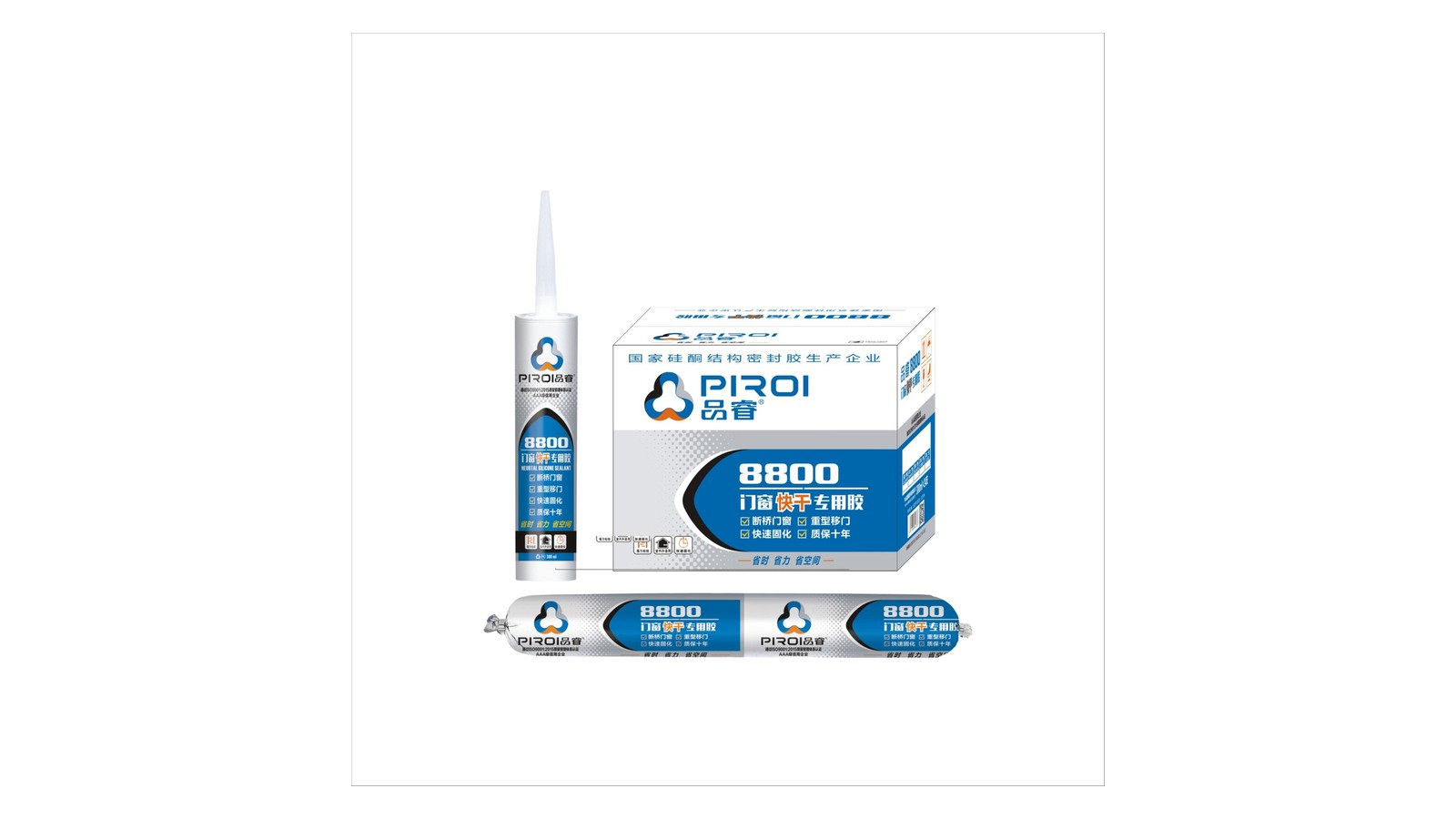
PIROI PR-8800 fast cure door and window silicone sealant — specifications
Test report 2025MK115, tested to JC/T 485-2007. A neutral cure fast cure silicone sealant engineered for door and window production lines.
- Tack-free in 0.8 hours — finished units can be handled the same shift
- Designed for high-throughput door and window production lines
- Excellent adhesion to glass, aluminium and stainless steel
- Neutral cure — safe for aluminium and coated profiles
- No sagging on vertical and overhead joints
- Transport as non-hazardous goods
- Shelf life 12 months; 300mL cartridge and 590mL sausage packaging
Typical applications
- Aluminium profile and glass assembly
- Fast-paced glazing production
- Shop-front and partition installation
- Window and door fabrication lines
Application notes
- Apply between 4°C and 40°C
- Not for oily or exuding surfaces
- Not for continuous water immersion
- For joint sealing — not for structural bonding
PIROI is a silicone sealant manufacturer in Zhongshan, China, with 8 automated filling lines and 17 models across four series. We support OEM and private label packing, sample testing before bulk orders, and full-container export. Contact us for the PR-8800 data sheet, MOQ and lead time, or the silicone sealant specifications for the full range.