

Silicone Sealant for Solar PV Modules
A solar installation is specified for 25 years, and the sealant is expected to last that long without being accessible for repair. On a solar panel array the pv sealant has to survive UV, daily thermal cycling and driving rain from the first day of service.
Why Solar Joints Are Specified for 25 Years
On a solar array the sealant is a warranty item, not a consumable.
- 25-Year Exposure: The joint is not maintainable. If it fails at year eight, the cost is access and labour, not the sealant.
- UV and Thermal Cycling: Modules swing from below freezing to 70°C+ surface temperature daily. The sealant has to survive thousands of cycles without hardening.
- Frame and Glass Adhesion: A solar frame sealant has to hold on anodised aluminium frames and on module glass, and each substrate needs different preparation. A bead that holds on one may peel from the other.
- Weather and Wind Load: Rooftop and ground-mount arrays see wind uplift and driving rain. Water ingress at the frame edge becomes a warranty claim.
How PIROI Solves It
A neutral cure grade formulated for long-term outdoor exposure on photovoltaic installations — supplied by a solar sealant manufacturer that tests every batch before release and archives the Certificate of Analysis for 18 months.
- UV Resistant: Formulated to resist UV degradation without chalking or losing elasticity.
- Weatherproof and Durable: This silicone sealant is designed for long-term outdoor exposure on rooftop and ground-mount arrays.
- Neutral Cure: No acetic acid to attack anodised aluminium frames or module edge seals.
- Elastic Across Temperature: Stays flexible across the daily temperature swing instead of hardening and cracking.
- Choosing a Solar Sealant Manufacturer: a 25-year installation cannot be repaired in place, so the supplier is effectively underwriting the service life. Ask for the neutral cure system in writing, the batch CoA from a delivered shipment, and the UV and thermal cycling results behind the grade — not a warranty statement.
- Related technical guides: solar panel sealant module frames, best sealant for high uv exposure, chinese vs astm sealant standards test report — each covers the engineering behind the grade you are specifying.
For a 25-year installation, ask for the ageing data rather than the initial adhesion figure. Tell us your mounting system and expected temperature range and we will confirm the grade and the test evidence we can provide.
Solar PV — Critical Engineering Parameters
UV Resistant
Formulated against UV degradation — no chalking, no loss of elasticity.
Weatherproof
Designed for long-term outdoor exposure on rooftop and ground-mount arrays.
Neutral Cure
No acetic acid to attack anodised frames or module edge seals.
Thermal Cycling
Stays elastic across the daily temperature swing instead of hardening and cracking.
Sealants for Solar PV
 New Energy
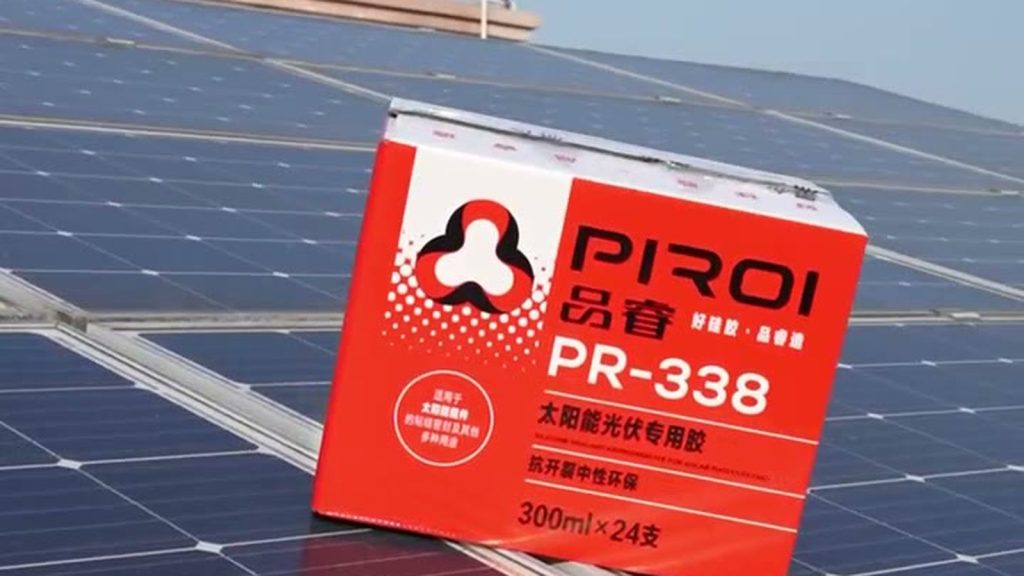
Solar PV Silicone Sealant
Specialized sealant for solar photovoltaic panel installation. UV resistant, weatherproof, durable sealing for renewable energy infrastructure.
View DetailsMOQ, Lead Time & Private Label
Installation Protocol for Solar PV
Confirm the Frame Finish and Module Type
Framed, frameless and bifacial modules seal differently. Check the frame finish before choosing preparation.
Clean the Bond Area
Remove handling oils and factory residue from the frame edge and glass. Clean the joint face, not the whole module.
Mask if Appearance Matters
On visible rooftop installations, mask the joint edges for a clean line, then remove the tape before skin forms.
Apply and Tool
One continuous bead with positive pressure. On large arrays, work in manageable sections so the bead is tooled before it skins.
Inspect Before Handover
Check the bead along the full frame perimeter. Water ingress at one missed section becomes a warranty claim later.
FAQs — Solar PV
How long will the sealant last on a solar installation?
It is formulated for long-term outdoor exposure, but the honest answer depends on your climate and mounting system. Ask us for the ageing data we hold and compare it with your project expected service life rather than relying on a single number.
Can it be used on anodised aluminium frames?
Yes — it is neutral cure, so no acetic acid is released to attack anodised aluminium or the module edge seal. Adhesion should still be confirmed on the actual frame finish.
Does it resist UV without chalking?
UV resistance is the primary design requirement for this grade. We can supply the test evidence we hold for your project file.
What about thermal cycling?
The sealant stays elastic across the daily temperature swing, which is the property that matters most on a module that heats and cools every day of its life.
What is the MOQ and lead time?
Standard OEM and private label MOQ is 1,000 pcs per model, with mixed-model trial orders from 3,000 pcs total and stock items from 500 pcs. Typical lead time is 15–25 days after artwork and sample approval.
Is a solar frame sealant the same as a potting adhesive?
No. A solar frame sealant is a flexible silicone bead that seals the frame-to-rail and frame-corner joints and lets the aluminium move with temperature. A potting adhesive is an encapsulating or structural product used inside the module or the junction box. PIROI supplies frame, rail and roof-penetration sealing — not module encapsulation — so if your specification calls for a potting compound, that is a different product category and we will say so rather than substitute.
What is pv sealant used for on a solar panel?
PV sealant is used on three details: the frame-to-rail joint, the frame corner joints, and the roof penetration where the mounting system passes through the membrane. Its job is to keep water out of the frame cavity and off the module edge for the life of the installation. The two properties that decide whether it succeeds are UV stability and adhesion to anodised aluminium and glass, which is why a neutral cure grade is required — acetic acid attacks anodised aluminium.
How do I choose a solar sealant manufacturer?
Ask three things. First, the neutral cure system in writing — acetic acid attacks anodised aluminium frames and the module edge. Second, a Certificate of Analysis from a shipment already delivered, so the batch record can be traced. Third, the UV and thermal cycling test results behind the grade, because a module joint is not maintainable and the evidence has to exist before installation rather than after failure.
Need pricing or a sample for Solar PV?
Tell us your substrate, joint dimensions and target market. We will come back with pricing, sample arrangements and the technical data sheet.
- Free adhesion & staining test on your own substrate sample
- OEM & private label from 1,000 pcs
- Typical lead time 15–25 days